

Short answer: Russian hackers targeted iOS and Android devices in Europe and the US. They used zero-click exploits to steal data.
TL;DR
- Russian hackers used zero-click exploits
- Targeted iOS and Android devices
- Exploits used previously patched vulnerabilities
What is CVE-2024-27834?
Russian hackers used zero-click exploits to target iOS and Android devices. They attacked high-profile websites, stealing data without user interaction.
- Vulnerability
- A mistake or weakness in software that an attacker can misuse.
- Exploit
- Code or steps that take advantage of a weakness.
Key facts
| Reported by | SecurityWeek |
|---|---|
| Date reported | 05 Nov 2026 |
| CVE | CVE-2024-27834 |
| CVSS | 5.5 MEDIUM CVSS:3.1/AV:L/AC:L/PR:L/UI:N/S:U/C:N/I:H/A:N |
| Weakness | CWE-287 (improper authentication) |
| CISA KEV | Yes, added 2026-11-04; federal due date 2026-11-18 |
| Ransomware use | Unknown (CISA KEV) |
| Vendor advisory | support.apple.com |
| CVE | CVE-2025-27038 |
| CVSS | 7.5 HIGH CVSS:3.1/AV:N/AC:H/PR:N/UI:R/S:U/C:H/I:H/A:H |
| Weakness | CWE-416 (use after free) |
| CISA KEV | Yes, added 2025-06-03; federal due date 2025-06-24 |
| Ransomware use | Unknown (CISA KEV) |
| Vendor advisory | docs.qualcomm.com |
| CVE | CVE-2026-3910 |
| CVSS | 8.8 HIGH CVSS:3.1/AV:N/AC:L/PR:N/UI:R/S:U/C:H/I:H/A:H |
| Weakness | CWE-119 (memory buffer error), CWE-94 (code injection) |
| CISA KEV | Yes, added 2026-03-13; federal due date 2026-03-27 |
| Ransomware use | Unknown (CISA KEV) |
| Vendor advisory | chromereleases.googleblog.com |
| Affected product | Apple Multiple Products |
| Published in NVD | 2024-05-14 (CVE-2024-27834) |
| Published in NVD | 2025-06-03 (CVE-2025-27038) |
| Published in NVD | 2026-03-13 (CVE-2026-3910) |
How it works
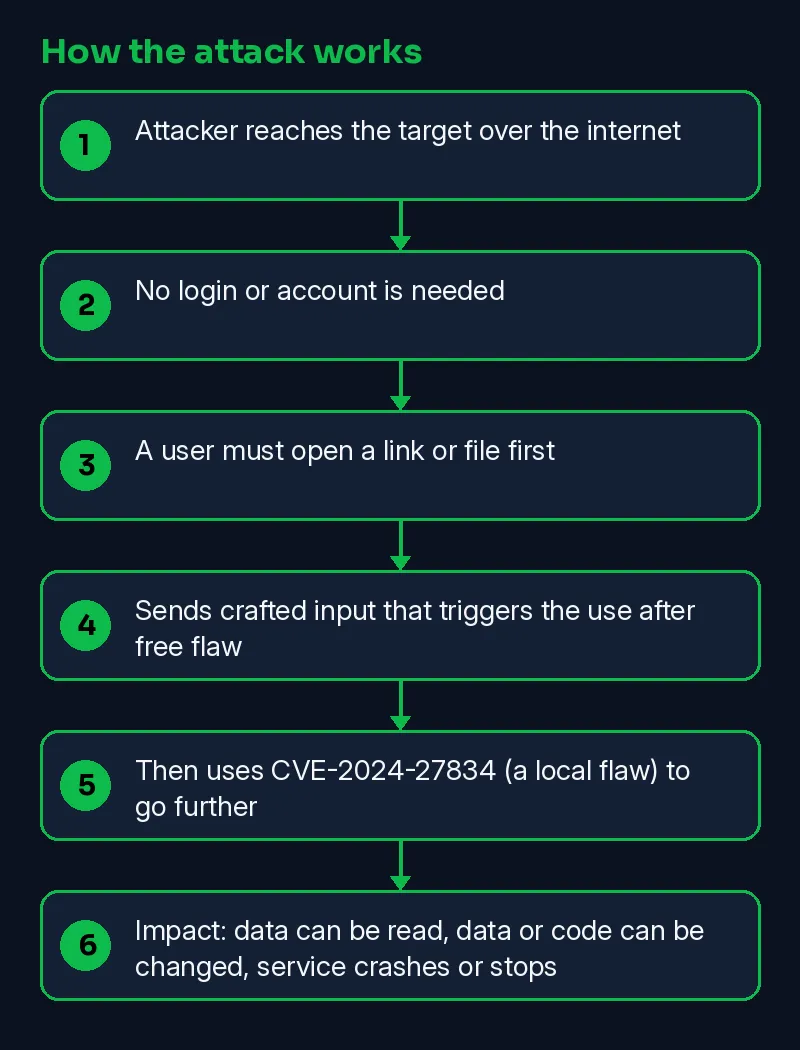
Russian hackers used watering holes, where they injected malicious code into popular websites. This harvested data and delivered exploits. They targeted iOS and Android with zero-click vulnerabilities, using exploit chains.
- Attacker reaches the target over the internet
- No login or account is needed
- A user must open a link or file first
- Sends crafted input that triggers the use after free flaw
- Then uses CVE-2024-27834 (a local flaw) to go further
- Impact: data can be read, data or code can be changed, service crashes or stops
Skillmate analyst mapping (our judgement, not from the vendor):
Timeline
| Date | Event | Source |
|---|---|---|
| 2024-05-14 | CVE-2024-27834 published in NVD | NVD |
| 2025-06-03 | CVE-2025-27038 added to CISA KEV (actively exploited) | CISA KEV |
| 2025-06-03 | CVE-2025-27038 published in NVD | NVD |
| 2025-06-24 | US federal agencies must patch by this date | CISA KEV |
| 2026-03-13 | CVE-2026-3910 added to CISA KEV (actively exploited) | CISA KEV |
| 2026-03-13 | CVE-2026-3910 published in NVD | NVD |
| 2026-03-27 | US federal agencies must patch by this date | CISA KEV |
| 2026-11-04 | CVE-2024-27834 added to CISA KEV (actively exploited) | CISA KEV |
| 2026-11-05 | Reported by SecurityWeek | SecurityWeek |
| 2026-11-18 | US federal agencies must patch by this date | CISA KEV |
| 2026-11-24 | This Skillmate explainer published | Skillmate |
Am I affected?
These commands only read the version or settings. Compare the output with the vendor advisory linked in the facts table.
Google Chrome
shows the Chrome version:
chrome://settings/help (type in the address bar)How to fix it
- Update Apple Multiple Products to the fixed release named in the vendor advisory.
- Read the vendor advisory for CVE-2024-27834 and upgrade to the fixed release it lists.
- CVE-2024-27834 is in CISA KEV: treat it as actively exploited and patch first.
- Read the vendor advisory for CVE-2025-27038 and upgrade to the fixed release it lists.
- CVE-2025-27038 is in CISA KEV: treat it as actively exploited and patch first.
- Read the vendor advisory for CVE-2026-3910 and upgrade to the fixed release it lists.
- CVE-2026-3910 is in CISA KEV: treat it as actively exploited and patch first.
- If you cannot patch today, limit who can reach the affected service and watch its logs.
How to detect it
Defenders should watch for unusual crashes, odd login attempts, and logs indicating code execution. A false positive might be a legitimate update check.
What is confirmed
- CVE-2024-27834 is a real NVD record scored 5.5 MEDIUM
- CISA lists CVE-2024-27834 as exploited in the wild
- CVE-2025-27038 is a real NVD record scored 7.5 HIGH
- CISA lists CVE-2025-27038 as exploited in the wild
- CVE-2026-3910 is a real NVD record scored 8.8 HIGH
- CISA lists CVE-2026-3910 as exploited in the wild
- Reported by SecurityWeek
- Reported by support.apple.com
- Reported by chromereleases.googleblog.com
Why it matters
This matters because it shows hackers can use popular sites to steal data. It highlights the importance of keeping devices updated and securing networks.
Learn the skills behind this story
Want to understand attacks like this and defend against them? Join Skillmate cybersecurity training or practise hands-on in Skillmate Labs.
FAQ
What is a watering hole attack?
A watering hole attack is when attackers compromise a website to target visitors, like infecting a popular site with malware.
How can I protect against zero-day vulnerabilities?
Keep your software up to date and use security patches promptly. This helps mitigate unknown vulnerabilities.
What are Pointer Authentication Codes?
Pointer Authentication Codes (PAC) are a security feature in iOS that helps prevent code execution from unauthorized code.
Related Skillmate posts
Sources
- Russia-Linked Hackers Hit iOS, Android Devices With Exploit Chains via Watering Holes (SecurityWeek)
- Vendor advisory CVE-2024-27834 (support.apple.com)
- Vendor advisory CVE-2026-3910 (chromereleases.googleblog.com)
- Vendor advisory CVE-2025-27038 (docs.qualcomm.com)
- NVD CVE record (NVD)
How we wrote this: facts come from the sources above, NVD and CISA KEV. An on-prem AI model drafted the plain-English parts and every sentence was checked against the sources; unsupported sentences were removed. MITRE mapping is our own judgement.
Watch today's video brief: https://youtu.be/yaK-CF987xg