

Short answer: Hackers exploited a flaw in ScreenConnect to hijack technicians' PCs. MSPs are affected. Update to version 26.6.5 or remove TransferFiles permission.
TL;DR
- Hackers used a flaw to hijack technicians' PCs.
- MSPs are at risk.
- Update to ScreenConnect 26.6.5.
- Or remove TransferFiles permission.
What is CVE-2026-84869?
A flaw in ScreenConnect allowed hackers to hijack technicians' PCs without permission. This happened because hackers could send files and run them through remote sessions. Hackers targeted managed service providers (MSPs) to gain access to customer data and systems. To protect, update to the latest version or remove permission to transfer files.
- Vulnerability
- A mistake or weakness in software that an attacker can misuse.
- Exploit
- Code or steps that take advantage of a weakness.
Key facts
| Reported by | The Hacker News |
|---|---|
| Date reported | 23 Nov 2026 |
| CVE | CVE-2026-84869 |
| CVSS | 9.9 CRITICAL CVSS:3.1/AV:N/AC:L/PR:L/UI:N/S:C/C:H/I:H/A:H |
| Weakness | CWE-269 (improper privilege management), CWE-862 (missing authorization) |
| CISA KEV | Yes, added 2026-09-11; federal due date 2026-09-14 |
| Ransomware use | Unknown (CISA KEV) |
| Vendor advisory | www.connectwise.com |
| Affected product | ConnectWise ScreenConnect |
| Published in NVD | 2026-09-08 (CVE-2026-84869) |
How it works
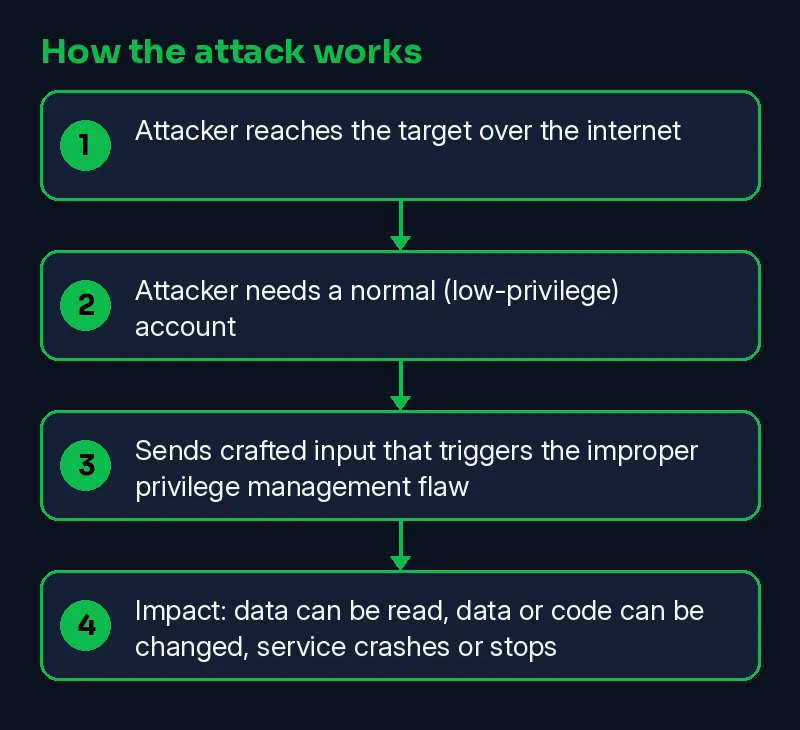
Hackers exploit a critical flaw in ScreenConnect that lets guests push files to a technician's machine without permission. The file runs automatically, giving attackers remote access.
- Attacker reaches the target over the internet
- Attacker needs a normal (low-privilege) account
- Sends crafted input that triggers the improper privilege management flaw
- Impact: data can be read, data or code can be changed, service crashes or stops
Timeline
| Date | Event | Source |
|---|---|---|
| 2026-09-08 | CVE-2026-84869 published in NVD | NVD |
| 2026-09-11 | CVE-2026-84869 added to CISA KEV (actively exploited) | CISA KEV |
| 2026-09-14 | US federal agencies must patch by this date | CISA KEV |
| 2026-11-23 | Reported by The Hacker News | The Hacker News |
| 2026-11-24 | This Skillmate explainer published | Skillmate |
How to fix it
- Update ConnectWise ScreenConnect to the fixed release named in the vendor advisory.
- Read the vendor advisory for CVE-2026-84869 and upgrade to the fixed release it lists.
- CVE-2026-84869 is in CISA KEV: treat it as actively exploited and patch first.
- If you cannot patch today, limit who can reach the affected service and watch its logs.
How to detect it
Defenders should look for unauthorized guest sessions, unexpected file transfers, and rogue ScreenConnect clients.
What is confirmed
- CVE-2026-84869 is a real NVD record scored 9.9 CRITICAL
- CISA lists CVE-2026-84869 as exploited in the wild
- Reported by The Hacker News
- Reported by www.connectwise.com
- Reported by www.huntress.com
Why it matters
This matters because it can lead to unauthorized access to sensitive systems, impacting data security and operational integrity. Companies should patch and secure their ScreenConnect installations.
Learn the skills behind this story
Want to understand attacks like this and defend against them? Join Skillmate cybersecurity training or practise hands-on in Skillmate Labs.
FAQ
What is CVE-2026-84869?
It is a critical flaw in ScreenConnect that allows guests to transfer and execute files without permission.
How can I protect my ScreenConnect installation?
Update to ScreenConnect 26.6.5 and remove the TransferFiles permission from roles if immediate patching is not possible.
What are the signs of a potential exploit?
Look for unauthorized guest sessions, unexpected file transfers, and rogue ScreenConnect clients on technician workstations.
What should I do if I suspect a compromise?
Isolate the affected servers, create backups, and follow established incident response procedures.
Related Skillmate posts
Sources
- Hackers Exploit Critical ScreenConnect Flaw to Hijack MSP Technician PCs Without Warning (The Hacker News)
- Primary source / advisory (www.connectwise.com)
- Primary source / advisory (www.huntress.com)
- Vendor advisory CVE-2026-84869 (www.connectwise.com)
- NVD CVE record (NVD)
How we wrote this: facts come from the sources above, NVD and CISA KEV. An on-prem AI model drafted the plain-English parts and every sentence was checked against the sources; unsupported sentences were removed. MITRE mapping is our own judgement.