

Short answer: A critical flaw in Idunno.AntiCsrf library allows hackers to execute code. Discontinue use and switch to a supported anti-CSRF solution.
TL;DR
- Idunno.AntiCsrf library has a flaw.
- Hackers can exploit it for RCE.
- Use updated anti-CSRF tools.
- Check IIS logs for suspicious activity.
What is CVE-2026-131914?
Idunno.AntiCsrf is a library for protecting websites from CSRF attacks. A recent flaw allows unauthenticated hackers to run code on the server. Discontinue its use and switch to newer, safer solutions.
- RCE (remote code execution)
- An attacker can run their own commands on someone else's computer or server over the internet.
- Vulnerability
- A mistake or weakness in software that an attacker can misuse.
- Exploit
- Code or steps that take advantage of a weakness.
Key facts
| Reported by | The Hacker News |
|---|---|
| Date reported | 23 Nov 2026 |
| CVE | CVE-2026-131914 |
| CVSS | 9.3 CRITICAL CVSS:4.0/AV:N/AC:L/AT:N/PR:N/UI:N/VC:H/VI:H/VA:H/SC:N/SI:N/SA:N/E:A/CR:X/IR:X/AR:X/MAV:X/MAC:X/MAT:X/MPR:X/MUI:X/MVC:X/MVI:X/MVA:X/MSC:X/MSI:X/MSA:X/S:X/AU:X/R:X/V:X/RE:X/U:X |
| Weakness | CWE-502 (unsafe deserialization) |
| CISA KEV | Not listed (no confirmed exploitation in KEV) |
| Affected product | ASP.NET |
| Published in NVD | 2026-11-19 (CVE-2026-131914) |
How it works
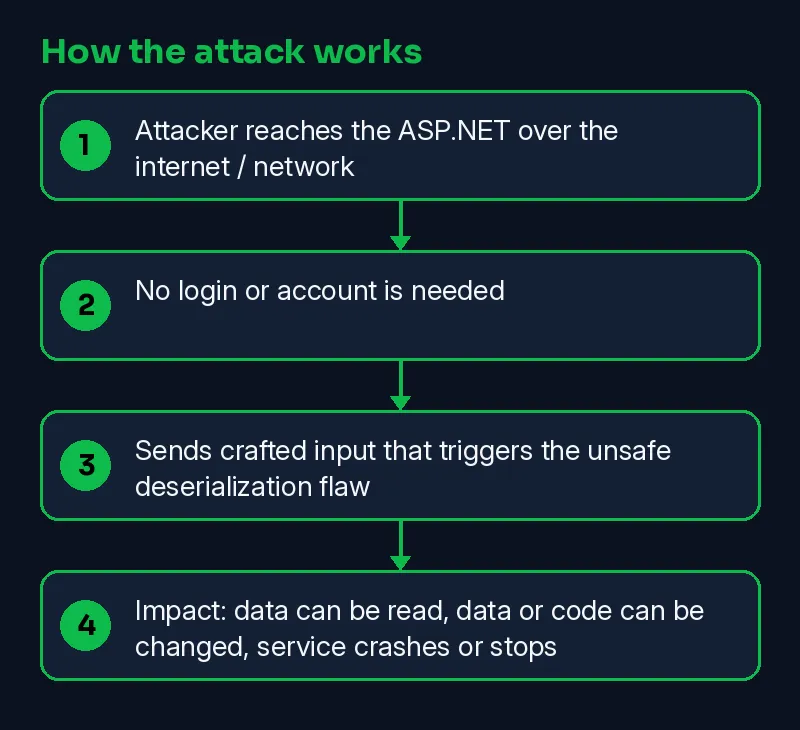
A flaw in Idunno.AntiCsrf library allows attackers to inject malicious code. The module deserializes untrusted data without proper verification, leading to RCE.
- Attacker reaches the ASP.NET over the internet / network
- No login or account is needed
- Sends crafted input that triggers the unsafe deserialization flaw
- Impact: data can be read, data or code can be changed, service crashes or stops
Skillmate analyst mapping (our judgement, not from the vendor):
- T1190 Exploit Public-Facing Application
Timeline
| Date | Event | Source |
|---|---|---|
| 2026-11-19 | CVE-2026-131914 published in NVD | NVD |
| 2026-11-23 | Reported by The Hacker News | The Hacker News |
| 2026-11-24 | This Skillmate explainer published | Skillmate |
How to fix it
- Update ASP.NET to the fixed release named in the vendor advisory.
- If you cannot patch today, limit who can reach the affected service and watch its logs.
How to detect it
Look for unusual POST requests to .aspx endpoints that return HTTP 302 or 500 with elevated cs-bytes.
What is confirmed and what is not
| Confirmed | Not confirmed yet |
|---|---|
| CVE-2026-131914 is a real NVD record scored 9.3 CRITICAL | CISA KEV does not list CVE-2026-131914 as exploited in the wild |
| Reported by The Hacker News | NVD links no vendor advisory for CVE-2026-131914 yet |
Why it matters
This flaw can be exploited by unauthenticated attackers, leading to server compromise. Companies must update or replace the library immediately.
Learn the skills behind this story
Want to understand attacks like this and defend against them? Join Skillmate cybersecurity training or practise hands-on in Skillmate Labs.
FAQ
What is a CSRF attack?
CSRF (Cross-Site Request Forgery) tricks a user into performing an action on a website without their intent.
How can I fix this vulnerability?
Replace the Idunno.AntiCsrf library with a supported anti-CSRF solution like ASP.NET Core Anti-Request Forgery.
What should I do if I find this library in my code?
Discontinue using it and review your IIS logs for suspicious POST requests.
Related Skillmate posts
Sources
- Hackers Exploit Critical ASP.NET Anti-CSRF Library Flaw Allowing Unauthenticated RCE (The Hacker News)
- NVD CVE record (NVD)
How we wrote this: facts come from the sources above, NVD and CISA KEV. An on-prem AI model drafted the plain-English parts and every sentence was checked against the sources; unsupported sentences were removed. MITRE mapping is our own judgement.