

Short answer: A flaw in Claude Dispatch allows malicious browser extensions to run code on your computer. Review extension permissions, keep apps updated, and monitor AI actions.
TL;DR
- Malicious extensions can send commands to Claude Desktop.
- Dispatch needs both a signed-in web and desktop session.
- Review permissions and update apps regularly.
- Monitor AI activities on your computer.
What happened?
This issue involves a security flaw in Claude Dispatch, a feature that lets users send tasks from their phone to their desktop's Claude AI. A malicious browser extension could exploit this flaw to run unauthorized code on the user's computer. The researchers recommend users review extension permissions and monitor AI activities.
- Vulnerability
- A mistake or weakness in software that an attacker can misuse.
Key facts
| Reported by | The Hacker News |
|---|---|
| Date reported | 06 Nov 2026 |
How it works
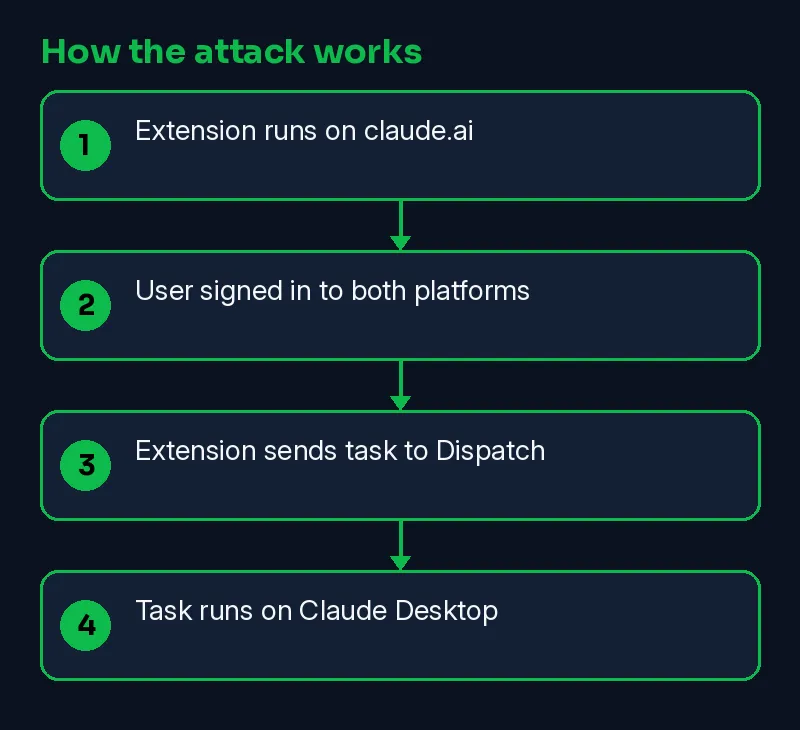
A malicious browser extension can use Dispatch, a feature of Claude Desktop, to run scripts on your computer. You must be signed in to both claude.ai and Claude Desktop with Dispatch turned on. The extension can send tasks to Claude Desktop, which can install packages or open apps, potentially giving the attacker access to your files and system.
- Extension runs on claude.ai
- User signed in to both platforms
- Extension sends task to Dispatch
- Task runs on Claude Desktop
Timeline
| Date | Event | Source |
|---|---|---|
| 2026-11-06 | Reported by The Hacker News | The Hacker News |
| 2026-11-25 | This Skillmate explainer published | Skillmate |
How to fix it
- Keep the operating system, browser and security software updated.
- Do not open unexpected attachments or install software from unofficial sources.
- Report suspicious files or pop-ups to your IT or security team.
How to detect it
Defenders should look for unexpected scripts running in their browser, odd logins, and crashes. A false positive could be a legitimate extension that suddenly starts acting maliciously.
Signs to watch for:
- Unknown programs starting at boot, or new scheduled tasks.
- Security software that was turned off without a reason.
- Unusual outbound connections from a workstation.
What is confirmed
- Reported by The Hacker News
- Reported by support.claude.com
Why it matters
This vulnerability allows attackers to compromise user systems through legitimate-looking extensions, posing a significant risk to personal and corporate data. Students and professionals should monitor their extensions and keep their software updated.
Learn the skills behind this story
Want to understand attacks like this and defend against them? Join Skillmate cybersecurity training or practise hands-on in Skillmate Labs.
FAQ
What is Dispatch?
Dispatch is a feature in Claude Desktop that lets users send tasks from their phone to their desktop, using local files and apps.
How can I protect myself?
Regularly update extensions, monitor what AI agents do on your computer, and review permissions.
Is Dispatch available to everyone?
Dispatch is in limited beta on some Pro, Max, and Ultra plans and isn't available to new users.
Can Dispatch be used maliciously?
Yes, a malicious extension can use Dispatch to run code on a user's computer, even when the computer is not awake.
Related Skillmate posts
Sources
- Malicious Browser Extensions Could Use Claude Dispatch to Run Code on Users' Computers (The Hacker News)
- Claude (primary source) (support.claude.com)
How we wrote this: facts come from the sources above. An on-prem AI model drafted the plain-English parts and every sentence was checked against the sources; unsupported sentences were removed. MITRE mapping is our own judgement.
Watch today's video brief: https://youtu.be/kRYzVvFUDME