
Short answer: A flaw in GPGME could allow data theft. Update to GPGME 2.3.1 if using GPG tools.
TL;DR
- GPGME flaw may let attackers steal data.
- Update to GPGME 2.3.1 if using GPG tools.
- Remote attackers may exploit the flaw.
What is CVE-2026-129975?
A flaw in GPGME, a library that helps programs use GnuPG, could allow attackers to steal data by sending malicious OpenPGP keys. To protect yourself, update your GPG tools to the latest version, especially GPGME 2.3.1.
- Vulnerability
- A mistake or weakness in software that an attacker can misuse.
Key facts
| Reported by | The Hacker News |
|---|---|
| Date reported | 21 Nov 2026 |
| CVE | CVE-2026-129975 |
| CVSS | 8.1 HIGH CVSS:3.1/AV:N/AC:H/PR:N/UI:N/S:U/C:H/I:H/A:H |
| Weakness | CWE-415 (see NVD) |
| CISA KEV | Not listed (no confirmed exploitation in KEV) |
| Vendor advisory | access.redhat.com |
| Affected product | GnuPG |
| Published in NVD | 2026-11-23 (CVE-2026-129975) |
How it works
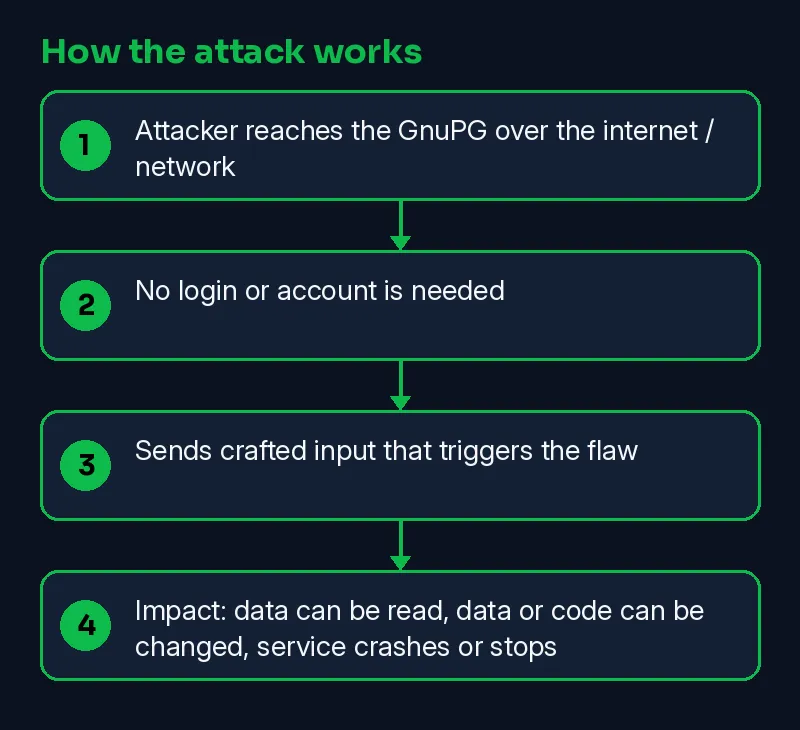
A long OpenPGP key can cause a memory bug in GPGME, which handles GnuPG in many applications.
- Attacker reaches the GnuPG over the internet / network
- No login or account is needed
- Sends crafted input that triggers the flaw
- Impact: data can be read, data or code can be changed, service crashes or stops
Skillmate analyst mapping (our judgement, not from the vendor):
- T1190 Exploit Public-Facing Application
Timeline
| Date | Event | Source |
|---|---|---|
| 2026-11-21 | Reported by The Hacker News | The Hacker News |
| 2026-11-23 | CVE-2026-129975 published in NVD | NVD |
| 2026-11-24 | This Skillmate explainer published | Skillmate |
How to fix it
- Update GnuPG to the fixed release named in the vendor advisory.
- Read the vendor advisory for CVE-2026-129975 and upgrade to the fixed release it lists.
- If you cannot patch today, limit who can reach the affected service and watch its logs.
What is confirmed and what is not
| Confirmed | Not confirmed yet |
|---|---|
| CVE-2026-129975 is a real NVD record scored 8.1 HIGH | CISA KEV does not list CVE-2026-129975 as exploited in the wild |
| Reported by The Hacker News | |
| Reported by access.redhat.com | |
| Reported by dev.gnupg.org | |
| Reported by gnupg.org |
Why it matters
This flaw affects many applications and could lead to data breaches or system failures.
Learn the skills behind this story
Want to understand attacks like this and defend against them? Join Skillmate cybersecurity training or practise hands-on in Skillmate Labs.
FAQ
What is GPGME?
GPGME is the standard library that programs use to interact with GnuPG for encryption and decryption tasks.
What does CVE-2026-129975 mean?
It's a flaw in GPGME that could allow attackers to corrupt memory, potentially leading to code execution or crashes.
How can I protect my software from this flaw?
Update to GPGME 2.3.1 or later, especially if your software uses GPGME before version 2.3.0.
Is this flaw easy to exploit?
Exploitation depends on factors like heap layout and allocator behavior, but untrusted signed data can cause crashes or memory corruption.
Related Skillmate posts
Sources
- GnuPG Warns Critical GPGME Flaw Could Expose App Data via Malicious OpenPGP Keys (The Hacker News)
- Vendor advisory CVE-2026-129975 (access.redhat.com)
- GnuPG (primary source) (dev.gnupg.org)
- GnuPG (primary source) (gnupg.org)
- NVD CVE record (NVD)
How we wrote this: facts come from the sources above, NVD and CISA KEV. An on-prem AI model drafted the plain-English parts and every sentence was checked against the sources; unsupported sentences were removed. MITRE mapping is our own judgement.
Watch today's video brief: https://youtu.be/08dUA1Ifaq8