

Short answer: Hackers exploit GeoServer flaws, potentially allowing unauthenticated RCE. Update to latest versions to protect systems.
TL;DR
- Two GeoServer vulnerabilities allow unauthenticated access and RCE.
- Exploits use file reads and URL fetches via WFS requests.
- Combine with other flaws for full remote code execution.
- Update GeoServer to versions 2.27.7, 2.28.6, or 3.0.2.
What happened?
This issue involves security vulnerabilities in GeoServer, a popular server for geospatial data. Hackers can exploit these flaws to gain unauthorized access and potentially execute malicious code. The vulnerabilities affect GeoServer versions and can be exploited through unauthenticated web service requests. Updating to the latest versions and securing the WFS service can help prevent exploitation.
- RCE (remote code execution)
- An attacker can run their own commands on someone else's computer or server over the internet.
- Vulnerability
- A mistake or weakness in software that an attacker can misuse.
- Exploit
- Code or steps that take advantage of a weakness.
Key facts
| Reported by | The Hacker News |
|---|---|
| Date reported | 25 Nov 2026 |
| CVE | CVE-2026-120705 (named by the sources; no NVD record yet) |
| CVE | CVE-2026-129243 (named by the sources; no NVD record yet) |
| CVE | CVE-2026-120704 (named by the sources; no NVD record yet) |
How it works
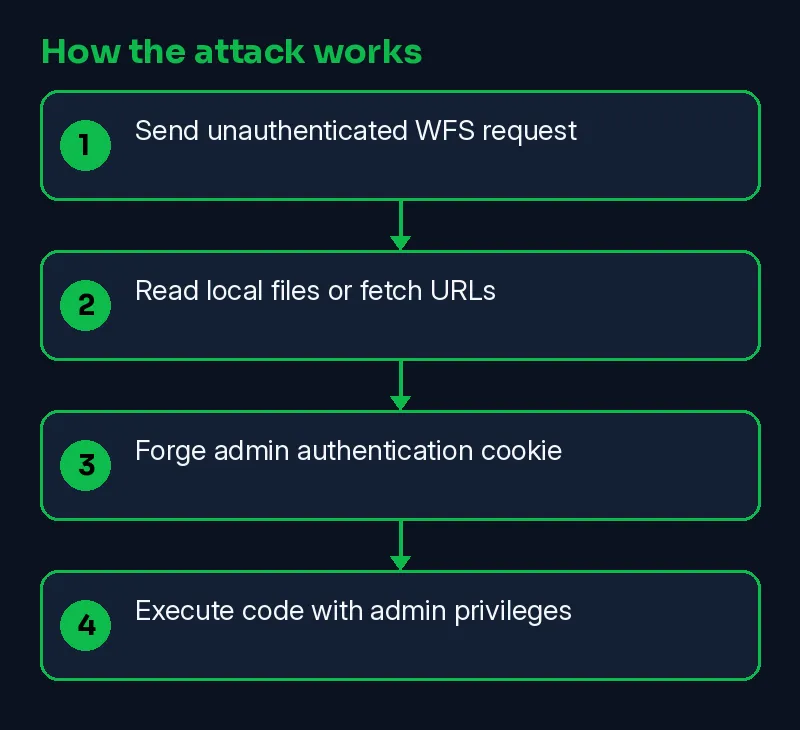
Hackers exploit two GeoServer flaws to read files, fetch URLs, and execute code. First, they use an unauthenticated WFS request to read files or fetch URLs. Finally, they use a stored query to access the data directory path, aiding further attacks.
- Send unauthenticated WFS request
- Read local files or fetch URLs
- Forge admin authentication cookie
- Execute code with admin privileges
Timeline
| Date | Event | Source |
|---|---|---|
| 2026-11-25 | Reported by The Hacker News | The Hacker News |
| 2026-11-25 | This Skillmate explainer published | Skillmate |
How to fix it
- Keep systems and network devices updated and follow vendor security notices.
- Make sure an incident response contact and plan exist before an attack happens.
- Ask your service providers which protections they offer, and test them.
How to detect it
Watch for unauthenticated access attempts to GeoServer, especially error messages related to file reads or remote code execution.
What is confirmed and what is not
| Confirmed | Not confirmed yet |
|---|---|
| Reported by The Hacker News | NVD has no record for CVE-2026-120705 yet |
| Reported by github.com | NVD has no record for CVE-2026-129243 yet |
| NVD has no record for CVE-2026-120704 yet |
Why it matters
Companies and users must update GeoServer to prevent unauthorized access and potential data breaches.
Learn the skills behind this story
Want to understand attacks like this and defend against them? Join Skillmate cybersecurity training or practise hands-on in Skillmate Labs.
FAQ
What are the main risks of these GeoServer vulnerabilities?
These vulnerabilities allow attackers to read files, execute code, and perform server-side request forgery without authentication, posing significant risks.
How can I protect my GeoServer installation?
Update to the latest versions of GeoServer (2.27.7, 2.28.6, 3.0.2) and GeoTools (33.7, 34.6, 35.2). Restrict or disable the WFS service for anonymous users.
What is unauthenticated remote code execution (RCE)?
Unauthenticated RCE means attackers can execute code on a server without needing to log in, which is a serious security risk.
Related Skillmate posts
Sources
- Hackers Exploit Two GeoServer Flaws as Researchers Warn of Unauthenticated RCE Chains (The Hacker News)
- Primary source / advisory (github.com)
- Primary source / advisory (github.com)
How we wrote this: facts come from the sources above. An on-prem AI model drafted the plain-English parts and every sentence was checked against the sources; unsupported sentences were removed. MITRE mapping is our own judgement.