

Short answer: A security flaw in WPIDE 3.6.0-3.6.4 allows unauthenticated attackers to execute code, but it's fixed in 3.6.5.
TL;DR
- Unauthenticated attackers can exploit a CSRF flaw.
- Code can be executed server-side without authentication.
- Fixed in version 3.6.5, update your plugin.
- Always keep your software updated.
What is CVE-2026-124251?
A security issue in WPIDE 3.6.0-3.6.4 allows unauthenticated attackers to perform actions as if they were logged-in administrators. By tricking a logged-in user, attackers can execute PHP code on the server, potentially leading to full control over the website. The problem is fixed in version 3.6.5, so it's crucial to update your software to avoid risks.
- RCE (remote code execution)
- An attacker can run their own commands on someone else's computer or server over the internet.
- Vulnerability
- A mistake or weakness in software that an attacker can misuse.
- CVE
- A public ID number (like CVE-2026-12345) given to a known security weakness so everyone can talk about the same bug.
- PHP
- A programming language used to build many websites, including WordPress sites.
Key facts
| Reported by | CyberScoop |
|---|---|
| Date reported | 23 Nov 2026 |
| CVE | CVE-2026-124251 |
| CVSS | 8.8 HIGH CVSS:3.1/AV:N/AC:L/PR:N/UI:R/S:U/C:H/I:H/A:H |
| Weakness | CWE-352 (cross-site request forgery) |
| CISA KEV | Not listed (no confirmed exploitation in KEV) |
| CVE | CVE-2026-57766 |
| CVSS | 8.8 HIGH CVSS:3.1/AV:N/AC:L/PR:N/UI:R/S:U/C:H/I:H/A:H |
| Weakness | CWE-352 (cross-site request forgery) |
| CISA KEV | Not listed (no confirmed exploitation in KEV) |
| Affected product | XplodedThemes WPIDE |
| Published in NVD | 2026-11-10 (CVE-2026-124251) |
| Published in NVD | 2026-07-02 (CVE-2026-57766) |
How it works
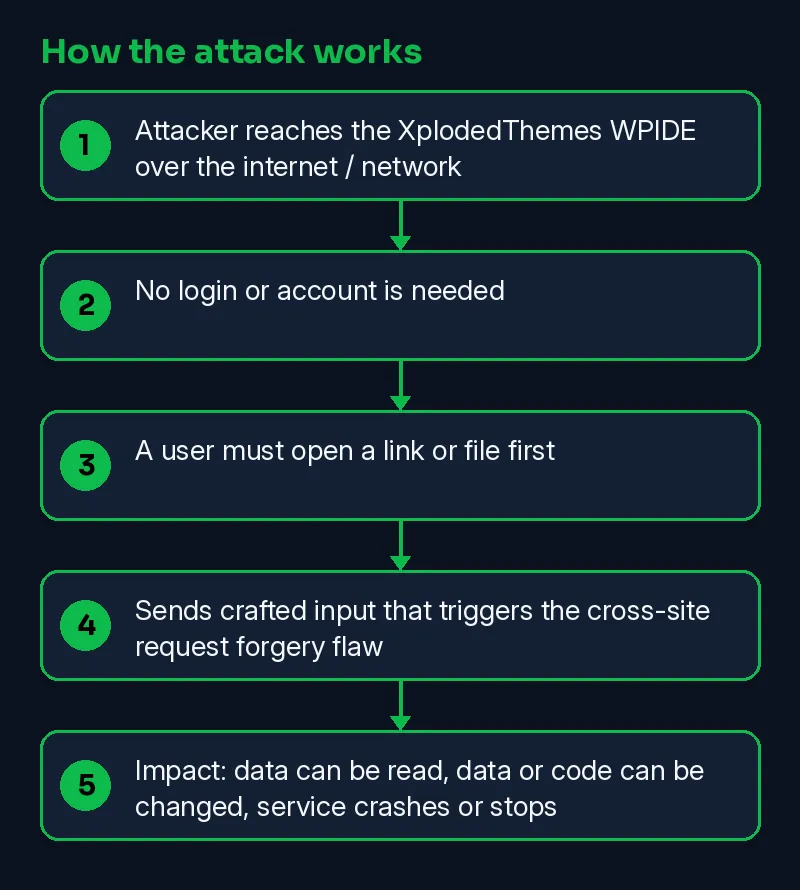
An attacker tricks a logged-in admin into performing actions on a website, leading to code execution. The WPIDE plugin has a flaw where it doesn’t check for CSRF protection on certain pages.
- Attacker reaches the XplodedThemes WPIDE over the internet / network
- No login or account is needed
- A user must open a link or file first
- Sends crafted input that triggers the cross-site request forgery flaw
- Impact: data can be read, data or code can be changed, service crashes or stops
Skillmate analyst mapping (our judgement, not from the vendor):
- T1190 Exploit Public-Facing Application
Timeline
| Date | Event | Source |
|---|---|---|
| 2026-07-02 | CVE-2026-57766 published in NVD | NVD |
| 2026-11-10 | CVE-2026-124251 published in NVD | NVD |
| 2026-11-23 | Reported by CyberScoop | CyberScoop |
| 2026-11-24 | This Skillmate explainer published | Skillmate |
How to fix it
- If you cannot patch today, limit who can reach the affected service and watch its logs.
How to detect it
Look for POST requests to /wp-admin/admin.php with a page parameter containing wpide%23%2F or /. Also check for POST requests with Content-Type: text/plain and a JSON-looking body.
What is confirmed and what is not
| Confirmed | Not confirmed yet |
|---|---|
| CVE-2026-124251 is a real NVD record scored 8.8 HIGH | CISA KEV does not list CVE-2026-124251 as exploited in the wild |
| CVE-2026-57766 is a real NVD record scored 8.8 HIGH | NVD links no vendor advisory for CVE-2026-124251 yet |
| Reported by CyberScoop | CISA KEV does not list CVE-2026-57766 as exploited in the wild |
| NVD links no vendor advisory for CVE-2026-57766 yet |
Why it matters
This affects security of websites. It can lead to data theft and unauthorized access.
Learn the skills behind this story
Want to understand attacks like this and defend against them? Join Skillmate cybersecurity training or practise hands-on in Skillmate Labs.
FAQ
What is CSRF?
CSRF is a type of attack that tricks a user into performing an unwanted action on a website they are logged into.
Is this vulnerability fixed?
Yes, the vulnerability is fixed in version 3.6.5 of WPIDE.
How can I protect my website?
Ensure you have the latest version of WPIDE installed and use strong, unique passwords.
Related Skillmate posts
Sources
- WPIDE 3.6.4 — CSRF Nonce Bypass Leading to Unauthenticated RCE (CVE-2026-124251) (CyberScoop)
- NVD CVE record (NVD)
How we wrote this: facts come from the sources above, NVD and CISA KEV. An on-prem AI model drafted the plain-English parts and every sentence was checked against the sources; unsupported sentences were removed. MITRE mapping is our own judgement.