

Short answer: Claude Code’s ‘Don't Ask Again’ file stored passwords and keys in 1,122 public GitHub repositories. Developers should rotate passwords and keys, and clean up files.
TL;DR
- Claude Code saved secret codes in public files.
- 1,122 repositories held secrets.
- Secrets could let attackers access databases, servers.
- Rotate passwords, tokens, keys, clean up files.
What happened at Code?
Claude Code’s ‘Don't Ask Again’ file saved secret codes like passwords and tokens. When users said ‘Yes, and don’t ask again’, Claude Code saved the secret in plain text. This happened in 1,122 public GitHub repositories, allowing anyone to read the secrets. Developers should change passwords and tokens, and clean up files.
- Credentials / secrets
- Passwords, keys and tokens that prove who you are to a system.
Key facts
| Reported by | The Hacker News |
|---|---|
| Date reported | 07 Nov 2026 |
How it works
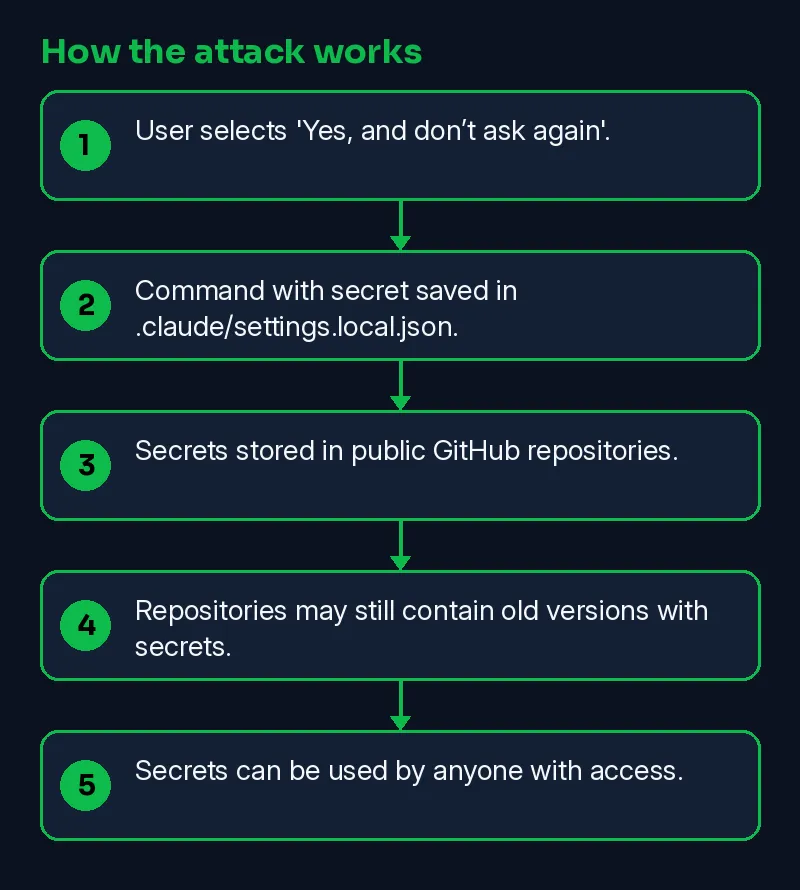
Claude Code's AI coding assistant saves commands with passwords and keys in a settings file. When users select 'Yes, and don’t ask again,' the assistant saves the entire command, including secrets, in plain text.
- User selects 'Yes, and don’t ask again'.
- Command with secret saved in .claude/settings.local.json.
- Secrets stored in public GitHub repositories.
- Repositories may still contain old versions with secrets.
- Secrets can be used by anyone with access.
Timeline
| Date | Event | Source |
|---|---|---|
| 2026-11-07 | Reported by The Hacker News | The Hacker News |
| 2026-11-25 | This Skillmate explainer published | Skillmate |
How to fix it
- If you have an account with the affected company, change that password and any reused copies of it.
- Turn on two-factor authentication (a second login step) wherever the service offers it.
- Expect phishing emails or calls that use the exposed details; verify requests through official channels.
How to detect it
Defenders can look for saved commands with passwords or keys in .claude/settings.local.json files in public GitHub repositories.
Signs to watch for:
- Login alerts from new devices or locations on the affected account.
- Password-reset emails you did not ask for.
- Phishing messages that quote your real account details.
What is confirmed
- Reported by The Hacker News
- Reported by code.claude.com
Why it matters
This matters because developers' secrets can be exposed, leading to data breaches and unauthorized access. Companies must rotate passwords and clean up repositories to protect sensitive information.
Learn the skills behind this story
Want to understand attacks like this and defend against them? Join Skillmate cybersecurity training or practise hands-on in Skillmate Labs.
FAQ
What is .claude/settings.local.json?
.claude/settings.local.json is a file that saves permission rules, including commands with passwords or keys, that users approve with 'Yes, and don’t ask again'.
How many repositories have this issue?
Apiiro found 1,122 public copies of .claude/settings.local.json files holding at least one secret, out of 103,617 repositories.
What should developers do?
Developers should search their GitHub organization for .claude/settings.local.json, check each repository’s git history, rotate passwords and tokens, and clean up the file.
Can this issue be fixed by removing the file?
Removing the file does not undo the leak, as older versions stay in git history and in forks of the repository.
Related Skillmate posts
Sources
- Claude Code's “Don't Ask Again” File Exposes Passwords and Keys in 1,122 Public Copies on GitHub (The Hacker News)
- Code (primary source) (code.claude.com)
- Code (primary source) (code.claude.com)
How we wrote this: facts come from the sources above. An on-prem AI model drafted the plain-English parts and every sentence was checked against the sources; unsupported sentences were removed. MITRE mapping is our own judgement.
Watch today's video brief: https://youtu.be/mPIabpGPAas