
Short answer: Developers are installing MCP servers that won't receive updates, making them vulnerable. This affects anyone using AI coding agents. Always check if a package is still supported before installing.
TL;DR
- AI coding agents are choosing outdated servers.
- These servers have known vulnerabilities but won't be patched.
- Developers are unaware, as they don't get warnings.
- Vulnerabilities can be exploited without users knowing.
What happened?
MCP servers are outdated servers installed by AI coding agents that developers might not be aware of. These servers have known security flaws but won't receive updates. Developers might unknowingly use these servers, increasing their risk of cyber attacks. Glow Labs found that four high-severity flaws exist in these servers, and they are still being installed more than 17.3 million times since July 2025.
- Vulnerability
- A mistake or weakness in software that an attacker can misuse.
- Patch
- A software update from the maker that fixes a security weakness.
- Exploit
- Code or steps that take advantage of a weakness.
- Unpatched
- No fix is available yet, or the fix has not been installed.
Key facts
| Reported by | Help Net Security |
|---|---|
| Date reported | 03 Nov 2026 |
How it works
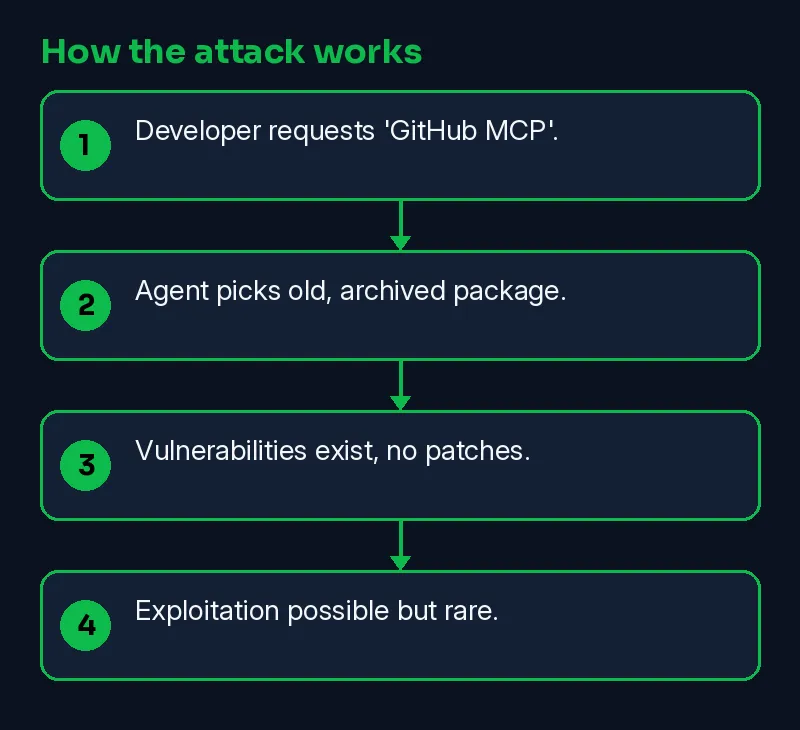
AI coding agents install old, unpatched MCP servers. Developers ask for 'GitHub MCP,' and the agent picks an outdated package. The server is archived, with no security updates. Developers approve it, thinking it's routine. Flaws exist but no CVEs or patches, making exploitation possible.
- Developer requests 'GitHub MCP'.
- Agent picks old, archived package.
- Vulnerabilities exist, no patches.
- Exploitation possible but rare.
Timeline
| Date | Event | Source |
|---|---|---|
| 2026-11-03 | Reported by Help Net Security | Help Net Security |
| 2026-11-05 | This Skillmate explainer published | Skillmate |
How to fix it
- Keep systems and network devices updated and follow vendor security notices.
- Make sure an incident response contact and plan exist before an attack happens.
- Ask your service providers which protections they offer, and test them.
How to detect it
Look for unusual server installations, especially from deprecated repositories. A false positive could be a routine update from a trusted source.
What is confirmed
- Reported by Help Net Security
Why it matters
This matters because unpatched servers pose security risks. Developers might unknowingly install vulnerabilities. Companies and users need to stay vigilant, especially with AI tools. Security teams should monitor and update dependencies to protect systems.
Learn the skills behind this story
Want to understand attacks like this and defend against them? Join Skillmate cybersecurity training or practise hands-on in Skillmate Labs.
FAQ
What are MCP servers?
MCP servers are outdated servers that developers might install through AI coding agents. They are not patched and can have security vulnerabilities.
How can I protect my system from these servers?
Check for unused or deprecated servers in your dependencies. Use security tools that monitor pre-execution hooks and npm deprecation status.
Are there any known vulnerabilities in these servers?
Yes, four high-severity vulnerabilities were found, including a remote code execution bug, but no exploitation has been seen yet.
How many times have these servers been downloaded?
These servers have been downloaded more than 17.3 million times since July 2025, with five of them in npm's top MCP 100.
Sources
- AI coding agents are installing MCP servers that will never be patched (Help Net Security)
How we wrote this: facts come from the sources above. An on-prem AI model drafted the plain-English parts and every sentence was checked against the sources; unsupported sentences were removed. MITRE mapping is our own judgement.