Short answer: A flaw was found in APT, the package manager used by Debian and Ubuntu, which could allow attackers to install unverified software with root privileges. Update APT and use HTTPS for package downloads to protect your systems.
TL;DR
- APT flaw could let attackers install unverified software.
- Debian, Ubuntu, and derivatives are affected.
- Update APT to the latest version.
- Use HTTPS for package downloads.
What is CVE-2026-109518?
APT is a package management system used by Debian, Ubuntu, and their derivatives. A recently discovered flaw in APT could allow attackers to install unverified software with root privileges if they manipulate HTTP traffic. This could lead to remote code execution. The issue is caused by the reuse of hard links and requires the client to follow redirects and retry downloads. Updating APT and using HTTPS can prevent this vulnerability.
- RCE (remote code execution)
- An attacker can run their own commands on someone else's computer or server over the internet.
- Vulnerability
- A mistake or weakness in software that an attacker can misuse.
- Patch
- A software update from the maker that fixes a security weakness.
- APT
- An 'advanced persistent threat': a skilled hacking group, often linked to a government, that stays hidden for a long time.
Key facts
| Reported by | CSO Online |
|---|---|
| Date reported | 05 Nov 2026 |
| CVE | CVE-2026-109518 |
| CVSS | 7.7 HIGH CVSS:4.0/AV:N/AC:L/AT:P/PR:N/UI:P/VC:H/VI:H/VA:H/SC:N/SI:N/SA:N/E:X/CR:X/IR:X/AR:X/MAV:X/MAC:X/MAT:X/MPR:X/MUI:X/MVC:X/MVI:X/MVA:X/MSC:X/MSI:X/MSA:X/S:X/AU:X/R:X/V:X/RE:X/U:X |
| Weakness | CWE-367 (see NVD), CWE-62 (see NVD) |
| CISA KEV | Not listed (no confirmed exploitation in KEV) |
| Vendor advisory | ubuntu.com |
| Affected product | Debian and Ubuntu |
| Published in NVD | 2026-11-04 (CVE-2026-109518) |
How it works
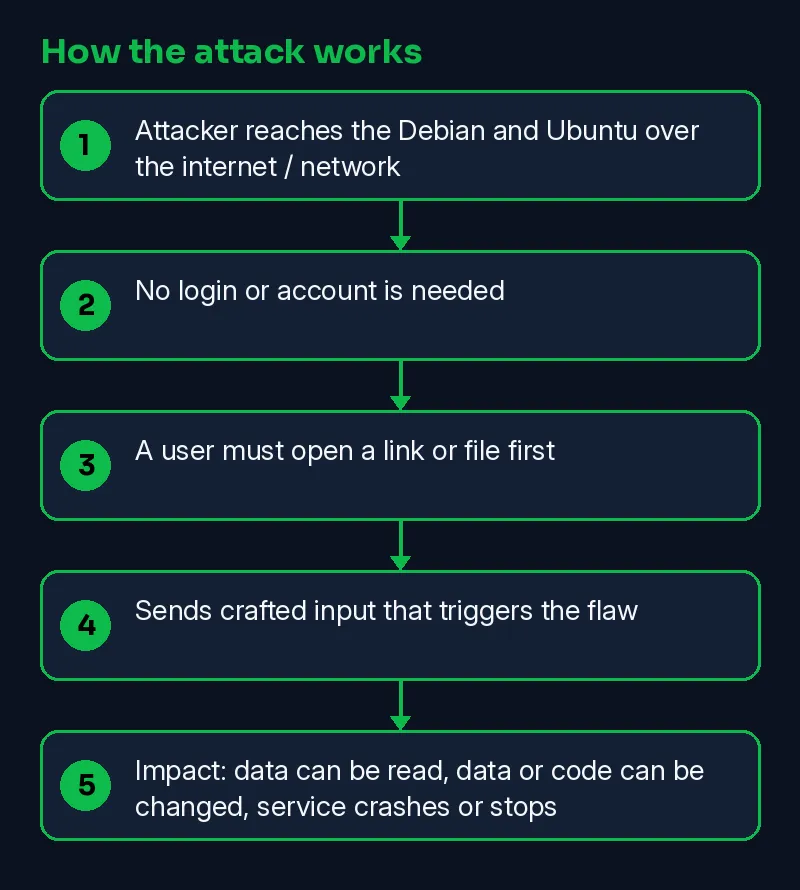
APT handles HTTP redirects and retries, allowing a bad guy to replace a package after verification. This can lead to arbitrary code execution as root. The vulnerability depends on APT’s Acquire::Retries setting being non-zero.
- Attacker reaches the Debian and Ubuntu over the internet / network
- No login or account is needed
- A user must open a link or file first
- Sends crafted input that triggers the flaw
- Impact: data can be read, data or code can be changed, service crashes or stops
Skillmate analyst mapping (our judgement, not from the vendor):
- T1190 Exploit Public-Facing Application
Timeline
| Date | Event | Source |
|---|---|---|
| 2026-11-04 | CVE-2026-109518 published in NVD | NVD |
| 2026-11-05 | Reported by CSO Online | CSO Online |
| 2026-11-06 | This Skillmate explainer published | Skillmate |
How to fix it
- Update Debian and Ubuntu to the fixed release named in the vendor advisory.
- Read the vendor advisory for CVE-2026-109518 and upgrade to the fixed release it lists.
- If you cannot patch today, limit who can reach the affected service and watch its logs.
What is confirmed and what is not
| Confirmed | Not confirmed yet |
|---|---|
| CVE-2026-109518 is a real NVD record scored 7.7 HIGH | CISA KEV does not list CVE-2026-109518 as exploited in the wild |
| Reported by CSO Online | |
| Reported by security-tracker.debian.org | |
| Reported by ubuntu.com |
Why it matters
This flaw could let attackers install malicious packages, gaining root access. Companies and users must update APT to prevent attacks and protect their systems.
Learn the skills behind this story
Want to understand attacks like this and defend against them? Join Skillmate cybersecurity training or practise hands-on in Skillmate Labs.
FAQ
How can I protect my system from this vulnerability?
Ensure your APT is updated to the latest version and use HTTPS for package downloads to protect against HTTP traffic manipulation.
What does the CVSS score of 7.7 mean?
A CVSS score of 7.7 indicates a high severity vulnerability, meaning it could allow attackers to execute code with root privileges.
What versions of Ubuntu are affected?
Ubuntu 22.04 LTS (Jammy Jellyfish) and newer are affected, while older versions are not vulnerable by default.
Sources
- Debian, Ubuntu patch APT flaw that could hand attackers root (CSO Online)
- Primary source / advisory (security-tracker.debian.org)
- Primary source / advisory (ubuntu.com)
- Vendor advisory CVE-2026-109518 (ubuntu.com)
- NVD CVE record (NVD)
How we wrote this: facts come from the sources above, NVD and CISA KEV. An on-prem AI model drafted the plain-English parts and every sentence was checked against the sources; unsupported sentences were removed. MITRE mapping is our own judgement.