
Short answer: AI-generated malware is harder to spot, but careful analysis can still identify it. Stay informed and update software regularly.
TL;DR
- AI makes malware harder to spot, but careful analysis can still identify it.
- Malware authors use AI to create more scripts and spread faster.
- Patches for vulnerabilities can be released quickly due to AI.
- Keep software updated to protect against new threats.
What happened?
AI-generated malware is software created using artificial intelligence, which makes it harder to detect. Malware authors use AI to create more scripts and spread them faster. This means defenders have less time to patch vulnerabilities. To protect yourself, keep your software updated regularly.
- Vulnerability
- A mistake or weakness in software that an attacker can misuse.
- Malware
- Harmful software made to spy, steal or damage.
Key facts
| Reported by | Help Net Security |
|---|---|
| Date reported | 04 Nov 2026 |
How it works
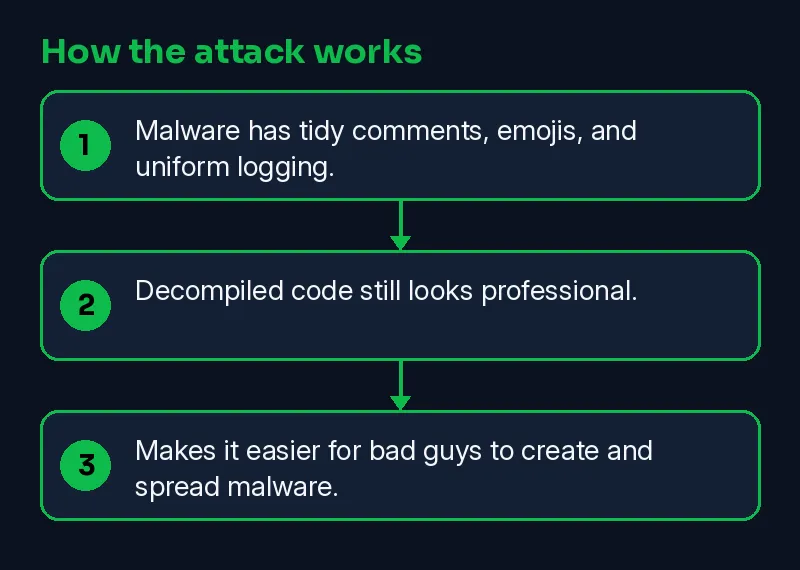
AI-generated malware can look like it was written by a human, with tidy comments and emojis. When decompiled, it shows uniform logging messages. This makes it easier for bad guys to create and spread malware quickly.
- Malware has tidy comments, emojis, and uniform logging.
- Decompiled code still looks professional.
- Makes it easier for bad guys to create and spread malware.
Timeline
| Date | Event | Source |
|---|---|---|
| 2026-11-04 | Reported by Help Net Security | Help Net Security |
| 2026-11-08 | This Skillmate explainer published | Skillmate |
How to fix it
- Keep the operating system, browser and security software updated.
- Do not open unexpected attachments or install software from unofficial sources.
- Report suspicious files or pop-ups to your IT or security team.
How to detect it
AI-generated malware often includes tidy comments and emojis in the code, which are unusual for actual malware. Logs might show strange messages. However, normal code might also look clean, so be careful.
Signs to watch for:
- Unknown programs starting at boot, or new scheduled tasks.
- Security software that was turned off without a reason.
- Unusual outbound connections from a workstation.
What is confirmed
- Reported by Help Net Security
Why it matters
AI speeds up malware creation, reducing the time before patches are needed. This means companies and users must be more vigilant and quicker to respond to threats.
Learn the skills behind this story
Want to understand attacks like this and defend against them? Join Skillmate cybersecurity training or practise hands-on in Skillmate Labs.
FAQ
What are some signs that malware might be AI-generated?
Malware may include comments and emojis that are typically found in professional code, making it look clean. However, normal code can also appear well-structured, so it’s important to carefully analyze it.
How does AI affect the patch window for vulnerabilities?
AI makes it easier for attackers to find and exploit vulnerabilities quickly, shrinking the time defenders have to patch them.
Sources
- What AI-generated malware looks like under the microscope (Help Net Security)
How we wrote this: facts come from the sources above. An on-prem AI model drafted the plain-English parts and every sentence was checked against the sources; unsupported sentences were removed. MITRE mapping is our own judgement.