

Short answer: A new zero-day vulnerability in Cacti allows unauthenticated attackers to gain remote code execution, affecting Cacti Core 1.2.31. Disable guest access and apply fixes.
TL;DR
- New zero-day vulnerability found in Cacti
- Can lead to remote code execution
- Affects latest Cacti version
- Disable guest access to mitigate risk
What happened?
A zero-day vulnerability in Cacti, an open-source network monitoring tool, allows attackers to execute commands remotely without authentication. This can be done through four HTTP requests, targeting the guest account. Disabling the guest account and applying security updates can prevent unauthorized access and protect sensitive network data.
- RCE (remote code execution)
- An attacker can run their own commands on someone else's computer or server over the internet.
- Vulnerability
- A mistake or weakness in software that an attacker can misuse.
- Zero-day
- A weakness attackers use before the maker has released a fix.
- Unpatched
- No fix is available yet, or the fix has not been installed.
- PHP
- A programming language used to build many websites, including WordPress sites.
Key facts
| Reported by | The Hacker News |
|---|---|
| Date reported | 27 Nov 2026 |
How it works
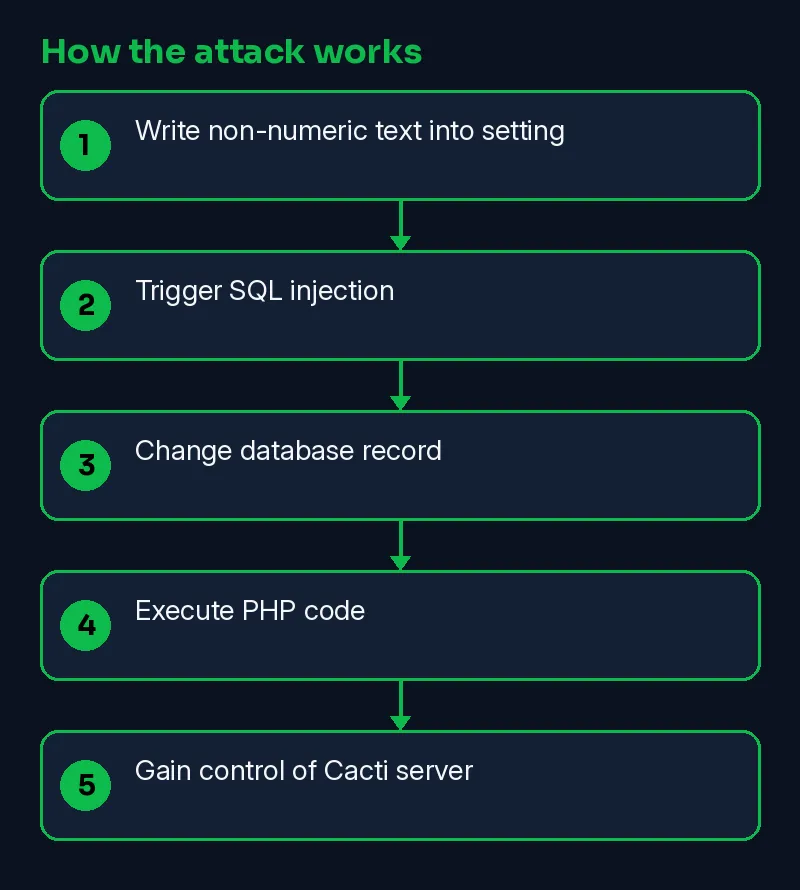
A security flaw in Cacti lets attackers write non-numeric text into a setting, leading to SQL injection. This changes a database record, which gets executed by PHP, allowing remote code execution.
- Write non-numeric text into setting
- Trigger SQL injection
- Change database record
- Execute PHP code
- Gain control of Cacti server
Skillmate analyst mapping (our judgement, not from the vendor):
- T1566 Phishing
Timeline
| Date | Event | Source |
|---|---|---|
| 2026-11-27 | Reported by The Hacker News | The Hacker News |
| 2026-11-27 | This Skillmate explainer published | Skillmate |
How to fix it
- Keep systems and network devices updated and follow vendor security notices.
- Make sure an incident response contact and plan exist before an attack happens.
- Ask your service providers which protections they offer, and test them.
What is confirmed
- Reported by The Hacker News
Why it matters
This flaw can let attackers access sensitive data and network devices, providing a foothold for further attacks. Companies and users should disable guest access and update Cacti.
Learn the skills behind this story
Want to understand attacks like this and defend against them? Join Skillmate cybersecurity training or practise hands-on in Skillmate Labs.
FAQ
What is a zero-day vulnerability?
A zero-day vulnerability is a security flaw that is unknown to the software vendor, making it difficult to fix quickly.
How can I protect my Cacti server?
Disable the guest account and limit access to the Cacti web interface. Review poller configuration for unexpected values.
What are the signs of this vulnerability being exploited?
Signs may include attempts to write non-numeric text into settings, followed by SQL injection and execution of commands.
Related Skillmate posts
Sources
How we wrote this: facts come from the sources above. An on-prem AI model drafted the plain-English parts and every sentence was checked against the sources; unsupported sentences were removed. MITRE mapping is our own judgement.