
Short answer: Ukrainian police arrested four suspects who stole €4.3 million from German victims through cryptocurrency scams. These scams tricked people into fake investments, stealing their money. Be cautious of unsolicited investment offers online.
TL;DR
- Ukrainian police arrested four scammers.
- Victims lost €4.3 million.
- Scammers used fake investment schemes.
- Be wary of online investment offers.
What happened?
This incident involves a group of scammers operating call centers in Ukraine, tricking people into fake cryptocurrency investments and stealing their money. The scammers built trust through social media and messaging apps, then guided victims to invest through fraudulent platforms.
Key facts
| Reported by | BleepingComputer |
|---|---|
| Date reported | 09 Nov 2026 |
How it works
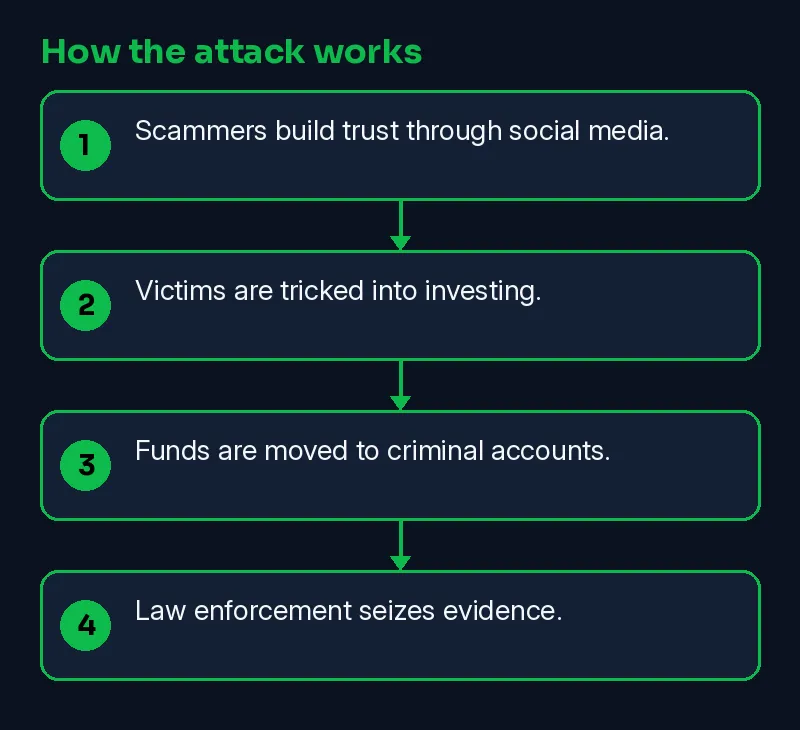
Scammers use fake investment schemes, often through social media and messaging apps, to build trust. They then trick victims into investing in fake trading platforms, stealing their funds.
- Scammers build trust through social media.
- Victims are tricked into investing.
- Funds are moved to criminal accounts.
- Law enforcement seizes evidence.
Skillmate analyst mapping (our judgement, not from the vendor):
- T1566 Phishing
Timeline
| Date | Event | Source |
|---|---|---|
| 2026-11-09 | Reported by BleepingComputer | BleepingComputer |
| 2026-11-27 | This Skillmate explainer published | Skillmate |
How to fix it
- If you keep crypto on an exchange, move long-term holdings to a wallet you control and turn on withdrawal address allow-lists.
- Use app-based or hardware-key two-factor authentication on exchange and wallet accounts, not SMS codes.
- Treat unexpected job offers, coding tests or trading apps sent over chat as suspicious; they are a common lure in crypto theft.
- Companies holding crypto: require more than one approver for large transfers and keep signing keys on separate, locked-down devices.
How to detect it
Defenders should watch for unusual online transactions, especially cryptocurrency exchanges.
Signs to watch for:
- Withdrawals to new addresses, or at unusual sizes or times.
- New devices, API keys or withdrawal addresses added to exchange or wallet accounts.
- Developer tools, packages or 'trading' apps installed right after a recruiter or job chat.
What is confirmed
- Reported by BleepingComputer
- Reported by The Record
Why it matters
This scam impacts victims' finances and highlights the need for better cybersecurity awareness and laws to protect users globally.
Learn the skills behind this story
Want to understand attacks like this and defend against them? Join Skillmate cybersecurity training or practise hands-on in Skillmate Labs.
FAQ
How did the criminals operate?
They built trust through social engineering, tricking victims into fake investment schemes through social media and messaging apps.
How much money did the scammers steal?
The scammers stole over €4.3 million from 135 victims in Germany.
What are the legal consequences for the scammers?
The four suspects face up to 12 years in prison and property confiscation if convicted.
Why was this case important?
This case highlights the efforts of Ukrainian law enforcement to crack down on fraudulent call centers and protect citizens from scams.
Sources
- Ukraine dismantles crypto scam network that stole €4.3 million (BleepingComputer)
- Ukraine arrests four in $5 million crypto scam targeting Germans (The Record)
How we wrote this: facts come from the sources above. An on-prem AI model drafted the plain-English parts and every sentence was checked against the sources; unsupported sentences were removed. MITRE mapping is our own judgement.
Watch today's video brief: https://youtu.be/fzBFP4ffN68