Short answer: Companies faced huge cloud bills due to stolen AI access, with some reaching $1 million. Monitor AI services and check for unauthorized changes.
TL;DR
- Stolen access to AI models led to high cloud costs.
- Attacks hit financial, retail, tech, and transportation sectors.
- Monitor AI services and check for unauthorized changes.
- Check for misconfigurations in cloud credentials.
What is CVE-2026-40217?
They generate large spikes in cloud charges by using stolen keys and services like Jet Night. To prevent this, regularly monitor AI services, secure cloud credentials, and watch for unauthorized changes.
- Credentials / secrets
- Passwords, keys and tokens that prove who you are to a system.
Key facts
| Reported by | Help Net Security |
|---|---|
| Date reported | 03 Nov 2026 |
| CVE | CVE-2026-40217 |
| CVSS | 8.8 HIGH CVSS:3.1/AV:N/AC:L/PR:L/UI:N/S:U/C:H/I:H/A:H |
| Weakness | CWE-420 (see NVD), CWE-94 (code injection) |
| CISA KEV | Not listed (no confirmed exploitation in KEV) |
| Vendor advisory | www.x41-dsec.de |
| Affected product | Stolen AI |
| Published in NVD | 2026-04-10 (CVE-2026-40217) |
| Amount reported | $1 million (as reported by Help Net Security) |
How it works
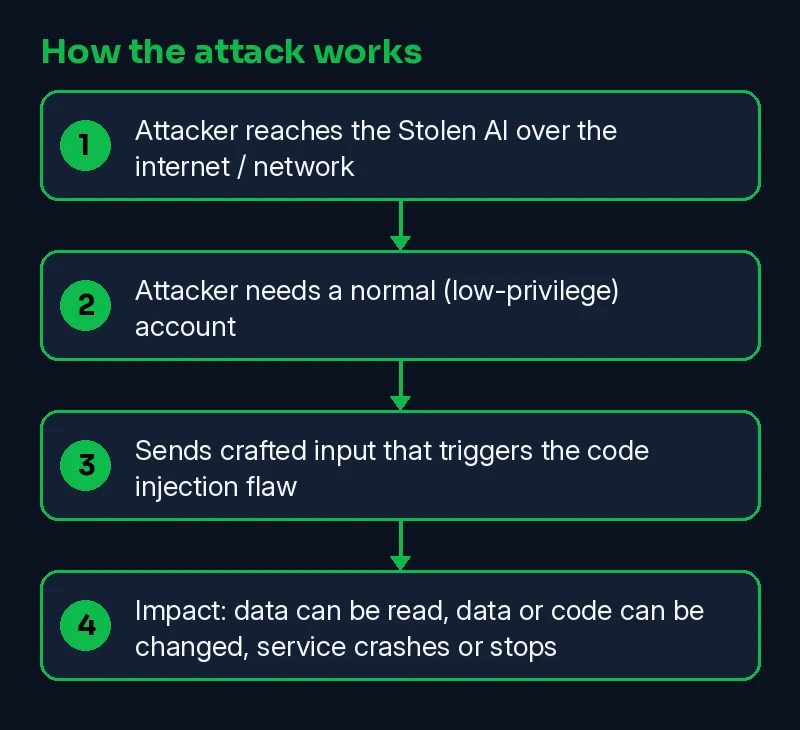
They use stolen keys to make API calls, which can cost up to $1 million. Some attackers also use stolen credentials to access backend resources directly, bypassing front-end interfaces.
- Attacker reaches the Stolen AI over the internet / network
- Attacker needs a normal (low-privilege) account
- Sends crafted input that triggers the code injection flaw
- Impact: data can be read, data or code can be changed, service crashes or stops
Skillmate analyst mapping (our judgement, not from the vendor):
- T1190 Exploit Public-Facing Application
Timeline
| Date | Event | Source |
|---|---|---|
| 2026-04-10 | CVE-2026-40217 published in NVD | NVD |
| 2026-11-03 | Reported by Help Net Security | Help Net Security |
| 2026-11-06 | This Skillmate explainer published | Skillmate |
How to fix it
- Update Stolen AI to the fixed release named in the vendor advisory.
- Read the vendor advisory for CVE-2026-40217 and upgrade to the fixed release it lists.
- If you cannot patch today, limit who can reach the affected service and watch its logs.
How to detect it
Look for unusual API requests and large cloud charges.
What is confirmed and what is not
| Confirmed | Not confirmed yet |
|---|---|
| CVE-2026-40217 is a real NVD record scored 8.8 HIGH | CISA KEV does not list CVE-2026-40217 as exploited in the wild |
| Help Net Security reports the amount as $1 million | |
| Reported by Help Net Security | |
| Reported by www.x41-dsec.de |
Why it matters
Companies and users need to secure their AI models and credentials to avoid such attacks.
Learn the skills behind this story
Want to understand attacks like this and defend against them? Join Skillmate cybersecurity training or practise hands-on in Skillmate Labs.
FAQ
What is LLMJacking?
LLMJacking is a type of attack where criminals use stolen AI access to run models at the victim's expense, generating large charges quickly.
How can attackers use stolen credentials?
Attackers can use stolen cloud credentials to access AI APIs and run models, leading to large and unexpected charges.
What should companies watch for in AI services?
Companies should watch for changes in AI service configurations and unexpected increases in cloud usage.
Sources
- Stolen AI access leaves companies with cloud bills of up to $1 million (Help Net Security)
- Vendor advisory CVE-2026-40217 (www.x41-dsec.de)
- NVD CVE record (NVD)
How we wrote this: facts come from the sources above, NVD and CISA KEV. An on-prem AI model drafted the plain-English parts and every sentence was checked against the sources; unsupported sentences were removed. MITRE mapping is our own judgement.