

Short answer: Veeam warned of boot failures on AMD EPYC hosts, affecting Veeam Software Appliance VMs. Users are advised to redeploy the appliance or disable automatic updates.
TL;DR
- Veeam warned of boot failures
- Affects Veeam Software Appliance VMs
- Mitigation: redeploy or disable updates
- Issue related to AMD EPYC processors
What is CVE-2026-98432?
Veeam warned of issues with Veeam Software Appliance boot failures on AMD EPYC hosts. The underlying Linux kernel runs health and cryptographic checks during early boot, which can fail on certain AMD processors, causing the VM to crash. To mitigate, users are advised to redeploy the appliance or disable automatic updates to manually monitor for issues.
Key facts
| Reported by | BleepingComputer |
|---|---|
| Date reported | 06 Nov 2026 |
| CVE | CVE-2026-98432 |
| CVSS | 9.8 CRITICAL CVSS:3.1/AV:N/AC:L/PR:N/UI:N/S:U/C:H/I:H/A:H |
| Weakness | CWE-416 (use after free) |
| CISA KEV | Not listed (no confirmed exploitation in KEV) |
| Affected product | Software Appliance |
| Published in NVD | 2026-10-15 (CVE-2026-98432) |
How it works
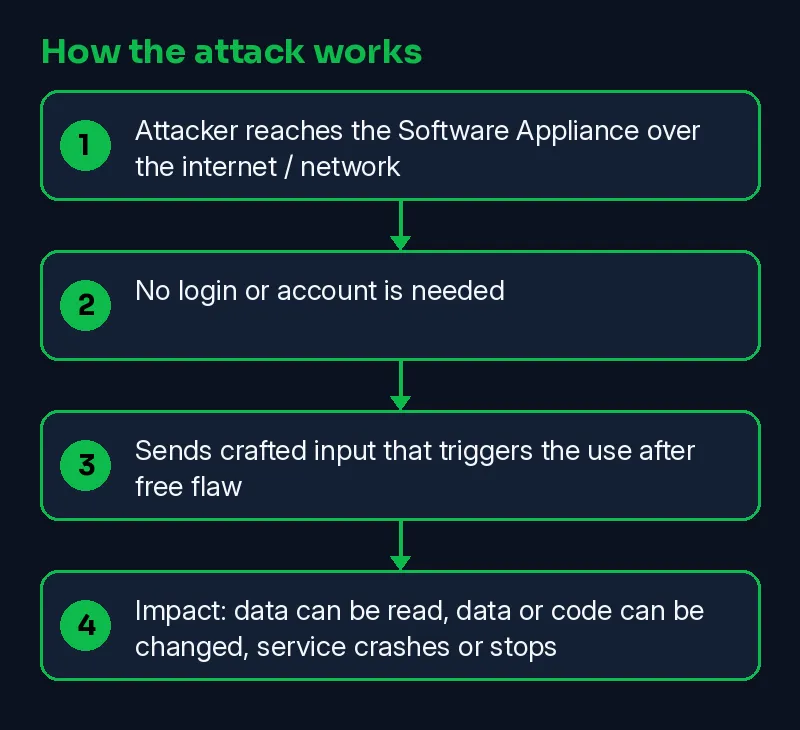
In Linux, when a VM tries to boot, it checks if it meets security rules. Sometimes, on AMD EPYC processors, it fails these checks, stopping the VM from starting.
- Attacker reaches the Software Appliance over the internet / network
- No login or account is needed
- Sends crafted input that triggers the use after free flaw
- Impact: data can be read, data or code can be changed, service crashes or stops
Skillmate analyst mapping (our judgement, not from the vendor):
- T1190 Exploit Public-Facing Application
Timeline
| Date | Event | Source |
|---|---|---|
| 2026-10-15 | CVE-2026-98432 published in NVD | NVD |
| 2026-11-06 | Reported by BleepingComputer | BleepingComputer |
| 2026-11-25 | This Skillmate explainer published | Skillmate |
Am I affected?
These commands only read the version or settings. Compare the output with the vendor advisory linked in the facts table.
Linux kernel
shows the running kernel version:
uname -rHow to fix it
- Update Software Appliance to the fixed release named in the vendor advisory.
- If you cannot patch today, limit who can reach the affected service and watch its logs.
How to detect it
Look for kernel panic errors with 'jitterentropy' in logs. A possible false positive is a system crash during a routine update.
What is confirmed and what is not
| Confirmed | Not confirmed yet |
|---|---|
| CVE-2026-98432 is a real NVD record scored 9.8 CRITICAL | CISA KEV does not list CVE-2026-98432 as exploited in the wild |
| Reported by BleepingComputer | NVD links no vendor advisory for CVE-2026-98432 yet |
Why it matters
This affects companies' ability to back up data, potentially causing service disruptions. It highlights the need for better security checks and compatibility in software.
Learn the skills behind this story
Want to understand attacks like this and defend against them? Join Skillmate cybersecurity training or practise hands-on in Skillmate Labs.
FAQ
What is jitterentropy?
Jitterentropy is a Linux kernel test that checks the quality of randomness. It may cause boot failures on Veeam Software Appliances on AMD EPYC processors.
Is there a fix for the boot failure issue?
Yes, redeploy the Veeam appliance on a system with a different processor or disable automatic updates and install them manually.
What is CVE-2026-98432?
It's a critical vulnerability in the Linux kernel's IPv4 TCP networking code that allows remote attackers to execute commands as root.
Sources
- Veeam warns of Software Appliance boot failures on AMD EPYC hosts (BleepingComputer)
- NVD CVE record (NVD)
How we wrote this: facts come from the sources above, NVD and CISA KEV. An on-prem AI model drafted the plain-English parts and every sentence was checked against the sources; unsupported sentences were removed. MITRE mapping is our own judgement.
Watch today's video brief: https://youtu.be/kRYzVvFUDME