
Short answer: Buyers should not assume a product is secure just because it has a certification. Check the product version and scope of the evaluation.
TL;DR
- Certification is a snapshot, not a guarantee of security.
- Vulnerabilities can be found after certification.
- Look for the exact product version and scope of evaluation.
- Higher assurance levels do not always mean more security.
What happened?
Security certification is a formal evaluation of a product's security features against specific criteria. It is a snapshot in time, not a guarantee of current security. Buyers often misunderstand what a certification means, thinking it ensures the product is free of vulnerabilities or fully secure. However, many vulnerabilities are found in certified products after certification. To avoid issues, check the exact product version and the scope of the evaluation.
- Vulnerability
- A mistake or weakness in software that an attacker can misuse.
Key facts
| Reported by | Help Net Security |
|---|---|
| Date reported | 06 Nov 2026 |
How it works
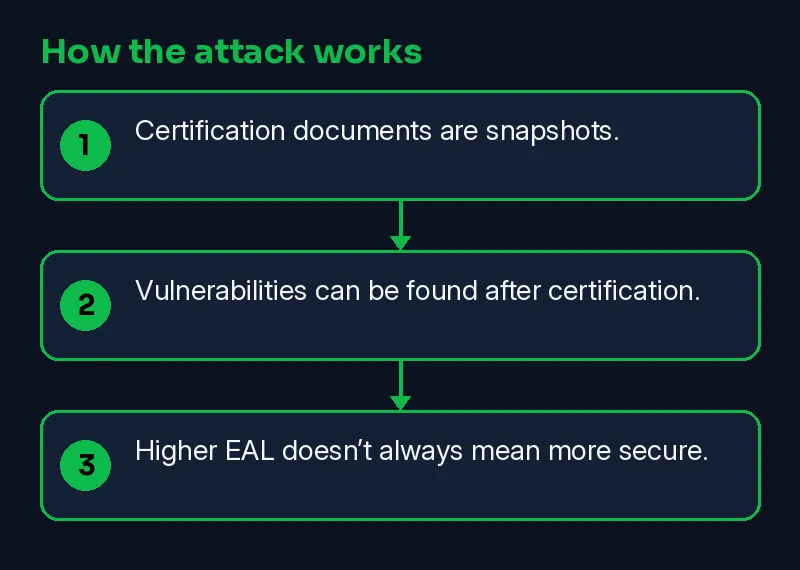
Security certification is a snapshot of a product’s security at a specific point in time. Buyers often assume it means the product is completely secure, but this isn't always true.
- Certification documents are snapshots.
- Vulnerabilities can be found after certification.
- Higher EAL doesn’t always mean more secure.
Timeline
| Date | Event | Source |
|---|---|---|
| 2026-11-06 | Reported by Help Net Security | Help Net Security |
| 2026-11-25 | This Skillmate explainer published | Skillmate |
How to fix it
- Keep systems and network devices updated and follow vendor security notices.
- Make sure an incident response contact and plan exist before an attack happens.
- Ask your service providers which protections they offer, and test them.
How to detect it
Buyers should look for the exact product name, version, and security claims in certification documents. However, a certificate is just a snapshot, so it may not cover current vulnerabilities or changes.
What is confirmed
- Reported by Help Net Security
Why it matters
Companies should not rely solely on certification documents for security. Buyers need to question vendors and look for specific details in documents.
Learn the skills behind this story
Want to understand attacks like this and defend against them? Join Skillmate cybersecurity training or practise hands-on in Skillmate Labs.
FAQ
What does a Common Criteria certificate promise?
It promises that an accredited lab evaluated a product against security claims, within a defined configuration and assurance level.
What are some common misunderstandings about certification?
Buyers often think 'certified' means no vulnerabilities, full product coverage, current version, or higher level means more secure. But these are not always true.
How long is a Common Criteria certificate valid?
A certificate usually has a validity of 5 years and then gets archived.
Sources
- Security certification is a snapshot, and buyers read too much into it (Help Net Security)
How we wrote this: facts come from the sources above. An on-prem AI model drafted the plain-English parts and every sentence was checked against the sources; unsupported sentences were removed. MITRE mapping is our own judgement.
Watch today's video brief: https://youtu.be/kRYzVvFUDME