
Short answer: Teams face challenges in reducing container vulnerabilities without disrupting applications. They should profile, harden, and validate container images to ensure security and functionality. Use runtime observation to identify unused components.
TL;DR
- Profile workload under representative conditions.
- Use execution-path map to guide removal.
- Validate hardened image before promotion.
- Integrate hardening into CI/CD systems.
What happened?
This issue is about securely managing container images to reduce vulnerabilities without breaking applications. Teams need to profile the application, identify unused components, and validate the hardened image. Automation in CI/CD helps achieve this consistently.
- Vulnerability
- A mistake or weakness in software that an attacker can misuse.
Key facts
| Reported by | Help Net Security |
|---|---|
| Date reported | 04 Nov 2026 |
How it works
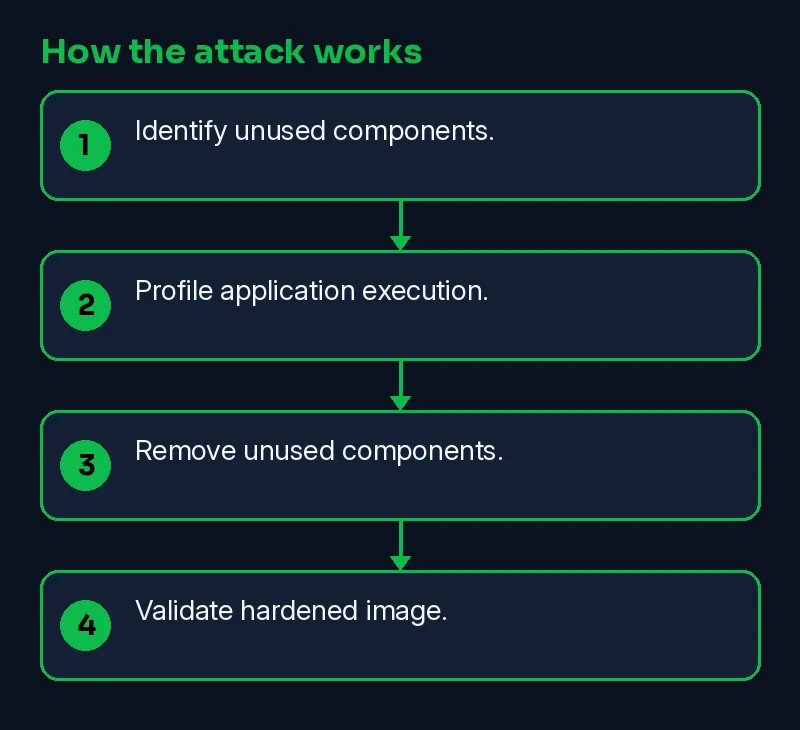
Container images often have extra tools and libraries that aren't needed by the application. This increases the risk of vulnerabilities. By profiling the application, teams can identify unused components and remove them, reducing the attack surface.
- Identify unused components.
- Profile application execution.
- Remove unused components.
- Validate hardened image.
Timeline
| Date | Event | Source |
|---|---|---|
| 2026-11-04 | Reported by Help Net Security | Help Net Security |
| 2026-11-08 | This Skillmate explainer published | Skillmate |
How to fix it
- Keep systems and network devices updated and follow vendor security notices.
- Make sure an incident response contact and plan exist before an attack happens.
- Ask your service providers which protections they offer, and test them.
What is confirmed
- Reported by Help Net Security
Why it matters
Reducing unused components in container images lowers the risk of vulnerabilities and makes systems more secure.
Learn the skills behind this story
Want to understand attacks like this and defend against them? Join Skillmate cybersecurity training or practise hands-on in Skillmate Labs.
FAQ
What is an SBOM?
An SBOM, or Software Bill of Materials, lists all the components in a container image, useful for inventory and compliance.
How does an RBOM help in container security?
An RBOM records which software components are actually used by a container, helping teams identify and remove unused and potentially risky components.
Why is profiling important in hardening containers?
Profiling captures a baseline of what the application does, helping teams make informed decisions about which components to keep or remove.
What is the purpose of validation in the hardening process?
Validation ensures the hardened image works as expected by running tests, comparing results, and keeping the original image as a backup.
Sources
- Secure your containers without breaking what works (Help Net Security)
How we wrote this: facts come from the sources above. An on-prem AI model drafted the plain-English parts and every sentence was checked against the sources; unsupported sentences were removed. MITRE mapping is our own judgement.