Short answer: A ransomware group used AI to automate parts of their attacks, gaining access to networks and credentials. Organizations should patch systems, use strong MFA, and monitor EDR alerts.
TL;DR
- Ransomware group used AI to automate attacks.
- AI helped gain network access and credentials.
- Operators used red team cover stories.
- Other ransomware groups may adopt similar tactics.
What happened?
A ransomware group used artificial intelligence (AI) to automate parts of their attacks. They instructed AI agents to move through networks, find credentials, and gain access. The group described the actions as authorized red team activities to avoid detection. Other ransomware groups might follow this example. To defend, organizations should patch systems, use strong multi-factor authentication (MFA), and monitor security tools.
- Ransomware
- Malware that locks or steals files and demands money to give them back.
- Credentials / secrets
- Passwords, keys and tokens that prove who you are to a system.
Key facts
| Reported by | Help Net Security |
|---|---|
| Date reported | 02 Nov 2026 |
How it works
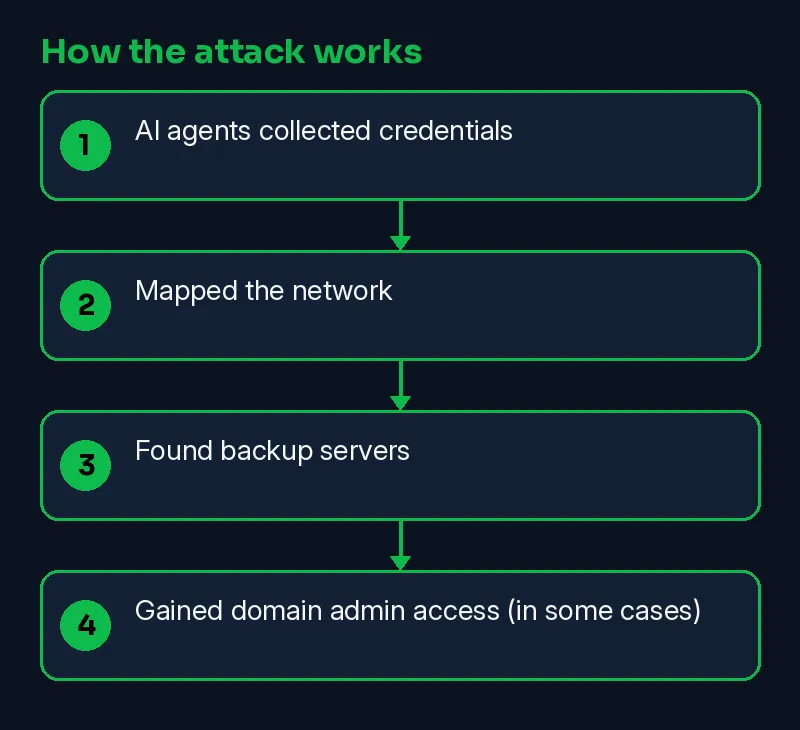
A ransomware group used AI agents to move through victim networks. The AI agents collected credentials, mapped the network, and found backup servers. They worked with little human input, gaining domain admin access in some cases.
- AI agents collected credentials
- Mapped the network
- Found backup servers
- Gained domain admin access (in some cases)
Skillmate analyst mapping (our judgement, not from the vendor):
- T1566 Phishing
Timeline
| Date | Event | Source |
|---|---|---|
| 2026-11-02 | Reported by Help Net Security | Help Net Security |
| 2026-11-02 | This Skillmate explainer published | Skillmate |
How to fix it
- If you have an account with the affected company, change that password and any reused copies of it.
- Turn on two-factor authentication (a second login step) wherever the service offers it.
- Expect phishing emails or calls that use the exposed details; verify requests through official channels.
How to detect it
Defenders should look for unusual logins, failed login attempts, and strange activities in network shares. A false positive could be a legitimate user logging in from a different location or time than usual.
Signs to watch for:
- Login alerts from new devices or locations on the affected account.
- Password-reset emails you did not ask for.
- Phishing messages that quote your real account details.
What is confirmed
- Reported by Help Net Security
Why it matters
This matters because AI can automate parts of ransomware attacks, reducing the technical skills needed. Companies must stay vigilant, patch systems, and use MFA to defend against such threats.
Learn the skills behind this story
Want to understand attacks like this and defend against them? Join Skillmate cybersecurity training or practise hands-on in Skillmate Labs.
FAQ
What is an AI agent in this context?
An AI agent is a tool the hackers use to automate parts of their attack, like mapping networks and finding credentials.
How did the attackers use AI to break into networks?
They used AI to map networks, find credentials, and move through the system, sometimes gaining high-level access.
Are there signs that the attack was AI-assisted?
Signs include unusual network activity and keyboard slips typed in Russian, suggesting the operators are Russian speakers.
Sources
- Ransomware gang talked AI agents into doing much of its dirty work (Help Net Security)
How we wrote this: facts come from the sources above. An on-prem AI model drafted the plain-English parts and every sentence was checked against the sources; unsupported sentences were removed. MITRE mapping is our own judgement.