Short answer: Police seized over 100 servers in a crackdown on an unnamed company suspected of running fraudulent trading websites, arresting seven suspects. Victims in at least 50 countries should be cautious of investment scams.
TL;DR
- Over 100 servers seized in fraud crackdown.
- Seven suspects arrested by European law enforcement.
- Investigation began after German couple couldn't withdraw funds.
- Victims in at least 50 countries affected.
What happened?
This incident involves a company providing fraudulent trading websites, targeting potential victims worldwide. The operation, supported by Europol and Eurojust, led to the seizure of servers and arrests of suspects involved in a 'crime-as-a-service' model. Victims were tricked into making small investments, which led to psychological pressure for larger transfers, but ultimately no ability to withdraw their money.
- PII
- Personally identifiable information: details like name, phone, address or health records.
Key facts
| Reported by | BleepingComputer |
|---|---|
| Date reported | 03 Nov 2026 |
How it works
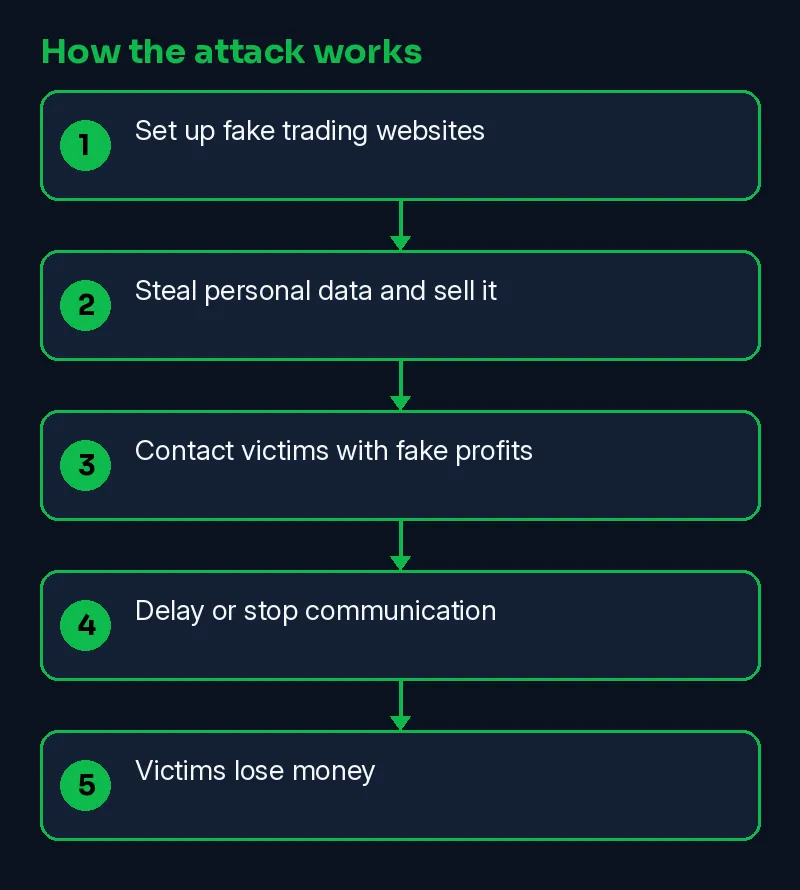
Scammers set up fake trading websites, offering quick profits. They steal personal data and sell it to call centers. Call center operators contact victims, promising easy money. Victims transfer small amounts, seeing fake profits. Scammers delay or stop communication, leaving victims with no funds.
- Set up fake trading websites
- Steal personal data and sell it
- Contact victims with fake profits
- Delay or stop communication
- Victims lose money
Timeline
| Date | Event | Source |
|---|---|---|
| 2026-11-03 | Reported by BleepingComputer | BleepingComputer |
| 2026-11-07 | This Skillmate explainer published | Skillmate |
How to fix it
- If you have an account with the affected company, change that password and any reused copies of it.
- Turn on two-factor authentication (a second login step) wherever the service offers it.
- Expect phishing emails or calls that use the exposed details; verify requests through official channels.
How to detect it
Defenders should look for unusual server activity, such as a sudden increase in traffic or logins from unknown locations.
Signs to watch for:
- Login alerts from new devices or locations on the affected account.
- Password-reset emails you did not ask for.
- Phishing messages that quote your real account details.
What is confirmed
- Reported by BleepingComputer
Why it matters
This scam targets many people, costing them their savings. It highlights the need for better cybersecurity awareness and protection. Companies and users should stay vigilant and report suspicious activities.
Learn the skills behind this story
Want to understand attacks like this and defend against them? Join Skillmate cybersecurity training or practise hands-on in Skillmate Labs.
FAQ
What is a 'crime-as-a-service' model?
A 'crime-as-a-service' model is when criminals offer illegal services, like fraudulent investment platforms, to other criminals. This helps expand their reach and profits.
How do scammers trick victims into transferring money?
Scammers use fake online accounts showing profits to make platforms seem legitimate. They encourage small transfers to create a sense of trust, then pressure victims into larger ones.
How many countries were involved in the investigation?
The investigation involved authorities from Albania, Cyprus, Finland, Germany, Kosovo, and North Macedonia, targeting potential victims in at least 50 countries.
Sources
- Police seizes over 100 servers in investment scam crackdown (BleepingComputer)
How we wrote this: facts come from the sources above. An on-prem AI model drafted the plain-English parts and every sentence was checked against the sources; unsupported sentences were removed. MITRE mapping is our own judgement.