

Short answer: Malware spread through Optimizely hit 178 organizations, including big names like BBC and Zoom. Apply security patches for Java and VMware products immediately.
TL;DR
- Malware spread through Optimizely hit 178 orgs
- Java4Shell flaw hard to exploit, but critical
- VMware vCenter zero-day exploited for months
- Apply security patches urgently to protect systems
What is CVE-2026-114938?
This incident involves a malware spreading through the Optimizely web platform, affecting 178 organizations. Additionally, there are critical vulnerabilities in Java and VMware products that could allow remote code execution. These vulnerabilities are severe and need immediate attention to prevent exploitation.
- RCE (remote code execution)
- An attacker can run their own commands on someone else's computer or server over the internet.
- Vulnerability
- A mistake or weakness in software that an attacker can misuse.
- Malware
- Harmful software made to spy, steal or damage.
- Exploit
- Code or steps that take advantage of a weakness.
Key facts
| Reported by | Help Net Security |
|---|---|
| Date reported | 22 Nov 2026 |
| CVE | CVE-2026-114938 |
| CVSS | 8.1 HIGH CVSS:3.1/AV:N/AC:H/PR:N/UI:N/S:U/C:H/I:H/A:H |
| Weakness | CWE-122 (heap buffer overflow) |
| CISA KEV | Not listed (no confirmed exploitation in KEV) |
| Vendor advisory | www.oracle.com |
| CVE | CVE-2026-115731 |
| CVSS | 9.4 CRITICAL CVSS:4.0/AV:N/AC:L/AT:N/PR:L/UI:N/VC:H/VI:H/VA:H/SC:H/SI:H/SA:H/E:X/CR:X/IR:X/AR:X/MAV:X/MAC:X/MAT:X/MPR:X/MUI:X/MVC:X/MVI:X/MVA:X/MSC:X/MSI:X/MSA:X/S:X/AU:X/R:X/V:X/RE:X/U:X |
| Weakness | CWE-502 (unsafe deserialization), CWE-94 (code injection) |
| CISA KEV | Yes, added 2026-11-17; federal due date 2026-12-01 |
| Ransomware use | Unknown (CISA KEV) |
| Vendor advisory | portal.perforce.com |
| CVE | CVE-2026-123890 |
| CVSS | 9.8 CRITICAL CVSS:3.1/AV:N/AC:L/PR:N/UI:N/S:U/C:H/I:H/A:H |
| Weakness | CWE-288 (authentication bypass) |
| CISA KEV | Yes, added 2026-11-20; federal due date 2026-11-23 |
| Ransomware use | Unknown (CISA KEV) |
| Vendor advisory | support.broadcom.com |
| Affected product | Perforce Puppet Enterprise |
| Published in NVD | 2026-11-17 (CVE-2026-114938) |
| Published in NVD | 2026-11-03 (CVE-2026-115731) |
| Published in NVD | 2026-11-19 (CVE-2026-123890) |
How it works
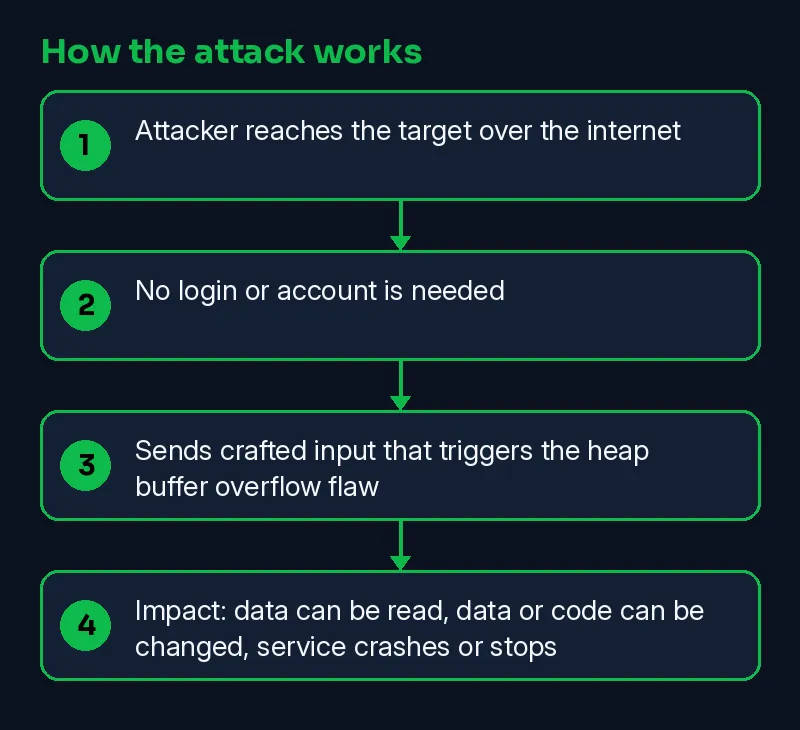
An attacker exploited a flaw in Optimizely’s platform to inject malicious JavaScript. This allowed them to plant malware on 178 organizations' websites without their knowledge.
- Attacker reaches the target over the internet
- No login or account is needed
- Sends crafted input that triggers the heap buffer overflow flaw
- Impact: data can be read, data or code can be changed, service crashes or stops
Skillmate analyst mapping (our judgement, not from the vendor):
- T1190 Exploit Public-Facing Application
Timeline
| Date | Event | Source |
|---|---|---|
| 2026-11-03 | CVE-2026-115731 published in NVD | NVD |
| 2026-11-17 | CVE-2026-114938 published in NVD | NVD |
| 2026-11-17 | CVE-2026-115731 added to CISA KEV (actively exploited) | CISA KEV |
| 2026-11-19 | CVE-2026-123890 published in NVD | NVD |
| 2026-11-20 | CVE-2026-123890 added to CISA KEV (actively exploited) | CISA KEV |
| 2026-11-22 | Reported by Help Net Security | Help Net Security |
| 2026-11-23 | US federal agencies must patch by this date | CISA KEV |
| 2026-11-24 | This Skillmate explainer published | Skillmate |
| 2026-12-01 | US federal agencies must patch by this date | CISA KEV |
How to fix it
- Update Perforce Puppet Enterprise to the fixed release named in the vendor advisory.
- Read the vendor advisory for CVE-2026-114938 and upgrade to the fixed release it lists.
- Read the vendor advisory for CVE-2026-115731 and upgrade to the fixed release it lists.
- CVE-2026-115731 is in CISA KEV: treat it as actively exploited and patch first.
- Read the vendor advisory for CVE-2026-123890 and upgrade to the fixed release it lists.
- CVE-2026-123890 is in CISA KEV: treat it as actively exploited and patch first.
- If you cannot patch today, limit who can reach the affected service and watch its logs.
How to detect it
Look for unusual network traffic, unexpected files, or changes in server logs. A false positive may be a legitimate update to software.
What is confirmed and what is not
| Confirmed | Not confirmed yet |
|---|---|
| CVE-2026-114938 is a real NVD record scored 8.1 HIGH | CISA KEV does not list CVE-2026-114938 as exploited in the wild |
| CVE-2026-115731 is a real NVD record scored 9.4 CRITICAL | |
| CISA lists CVE-2026-115731 as exploited in the wild | |
| CVE-2026-123890 is a real NVD record scored 9.8 CRITICAL | |
| CISA lists CVE-2026-123890 as exploited in the wild | |
| Reported by Help Net Security | |
| Reported by www.oracle.com | |
| Reported by support.broadcom.com |
Why it matters
This highlights the need for robust web platform security and regular updates. Companies must vigilantly monitor their online presence to prevent such attacks.
Learn the skills behind this story
Want to understand attacks like this and defend against them? Join Skillmate cybersecurity training or practise hands-on in Skillmate Labs.
Related Skillmate posts
Sources
- Week in review: Java4Shell proves tricky to exploit, malware planted via Optimizely hits 178 orgs (Help Net Security)
- Vendor advisory CVE-2026-114938 (www.oracle.com)
- Vendor advisory CVE-2026-123890 (support.broadcom.com)
- Vendor advisory CVE-2026-115731 (portal.perforce.com)
- NVD CVE record (NVD)
How we wrote this: facts come from the sources above, NVD and CISA KEV. An on-prem AI model drafted the plain-English parts and every sentence was checked against the sources; unsupported sentences were removed. MITRE mapping is our own judgement.
Watch today's video brief: https://youtu.be/Gyqu7KhN9u8