

Short answer: Over 575 malicious OpenClaw skills delivered malware to Windows and macOS.
TL;DR
- Malware delivered by OpenClaw skills targeted Windows and macOS.
- Cybercriminals use AI and stolen credentials for attacks.
- Tools interfere with system recovery and detection.
- Stolen sessions can give attackers access to cloud services.
What happened at OpenClaw?
OpenClaw skills are malicious software that disguised as legitimate tools. They can deliver malware, like trojans and miners, to Windows and macOS systems. Cybercriminals use AI and stolen credentials to coordinate attacks. These tools can interfere with system recovery and detection. Stolen sessions can give attackers access to cloud services without triggering MFA.
- Malware
- Harmful software made to spy, steal or damage.
- Credentials / secrets
- Passwords, keys and tokens that prove who you are to a system.
Key facts
| Reported by | Help Net Security |
|---|---|
| Date reported | 10 Nov 2026 |
How it works
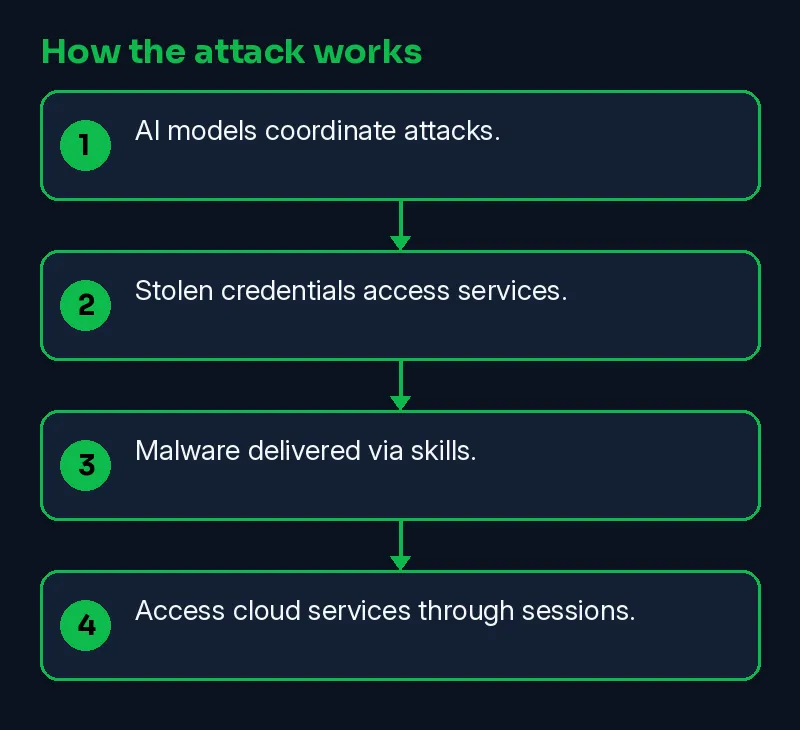
Attackers use AI agents to target systems, steal credentials, and evade detection. They deliver malware via skills posing as legitimate tools. Malware includes trojans, miners, and stealers. Operators control agents through messaging apps and use stolen sessions to access cloud services.
- AI models coordinate attacks.
- Stolen credentials access services.
- Malware delivered via skills.
- Access cloud services through sessions.
Skillmate analyst mapping (our judgement, not from the vendor):
- T1486 Data Encrypted for Impact
Timeline
| Date | Event | Source |
|---|---|---|
| 2026-11-10 | Reported by Help Net Security | Help Net Security |
| 2026-11-28 | This Skillmate explainer published | Skillmate |
How to fix it
- If you have an account with the affected company, change that password and any reused copies of it.
- Turn on two-factor authentication (a second login step) wherever the service offers it.
- Expect phishing emails or calls that use the exposed details; verify requests through official channels.
How to detect it
Signs to watch for:
- Login alerts from new devices or locations on the affected account.
- Password-reset emails you did not ask for.
- Phishing messages that quote your real account details.
What is confirmed
- Reported by Help Net Security
Why it matters
This matters as it compromises systems, steals data, and evades detection.
Learn the skills behind this story
Want to understand attacks like this and defend against them? Join Skillmate cybersecurity training or practise hands-on in Skillmate Labs.
FAQ
What are OpenClaw skills?
OpenClaw skills are malicious programs that disguise as useful tools but deliver malware to Windows and macOS systems.
How do attackers use stolen credentials?
Attackers use stolen browser sessions to access cloud services without triggering multi-factor authentication challenges.
What is the Red Heron campaign?
In the Red Heron campaign, attackers exploited a public exploit for a critical Gitea vulnerability to steal repositories and credentials.
How can ransomware affect virtualization hosts?
The ESXi variant of ransomware can shut down virtual machines to encrypt their files, disrupting virtualization hosts and recovery options.
Sources
- Over 575 malicious OpenClaw skills delivered malware to Windows and macOS (Help Net Security)
How we wrote this: facts come from the sources above. An on-prem AI model drafted the plain-English parts and every sentence was checked against the sources; unsupported sentences were removed. MITRE mapping is our own judgement.
Watch today's video brief: https://youtu.be/e-8gKIJlbPQ