

Short answer: A new flaw in Linux servers can let attackers gain root access. Systems with old Linux kernels are at risk. Apply patches or restrict access.
TL;DR
- Vulnerability in Linux NFS server allows remote attackers to gain root access.
- Affects Linux systems with kernels older than 6.12.117, 6.18.61, 7.3.2, or 7.4-rc1.
- Exploitation requires sending malicious requests to the NFS server.
- Apply kernel updates or restrict access to TCP port 2049.
What is CVE-2026-99362?
The NFS2ROOT vulnerability is a critical flaw in the Linux NFS server that enables remote attackers to gain root privileges. It exists in older Linux kernels and can be exploited by sending specially crafted requests. Security teams should apply patches or limit access to mitigate risks.
- Vulnerability
- A mistake or weakness in software that an attacker can misuse.
- Patch
- A software update from the maker that fixes a security weakness.
- Exploit
- Code or steps that take advantage of a weakness.
Key facts
| Reported by | BleepingComputer |
|---|---|
| Date reported | 27 Nov 2026 |
| CVE | CVE-2026-99362 |
| CVSS | 9.8 CRITICAL CVSS:3.1/AV:N/AC:L/PR:N/UI:N/S:U/C:H/I:H/A:H |
| CISA KEV | Not listed (no confirmed exploitation in KEV) |
| Affected product | NFS2ROOT Linux |
| Published in NVD | 2026-11-19 (CVE-2026-99362) |
How it works
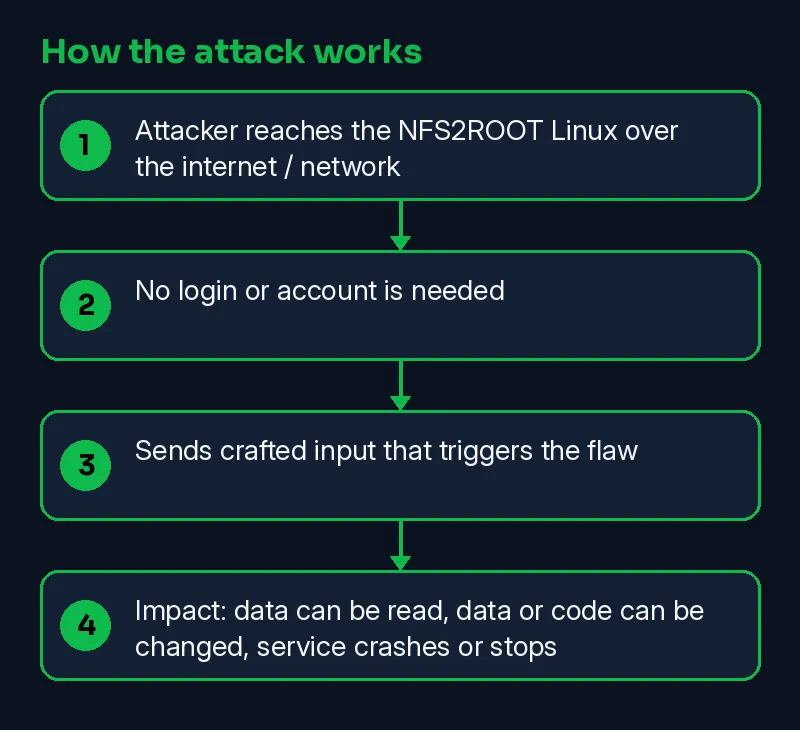
An attacker sends a malicious request to the NFS server. The request overflows a buffer, corrupting kernel memory. This lets the attacker execute commands with root privileges.
- Attacker reaches the NFS2ROOT Linux over the internet / network
- No login or account is needed
- Sends crafted input that triggers the flaw
- Impact: data can be read, data or code can be changed, service crashes or stops
Timeline
| Date | Event | Source |
|---|---|---|
| 2026-11-19 | CVE-2026-99362 published in NVD | NVD |
| 2026-11-27 | Reported by BleepingComputer | BleepingComputer |
| 2026-11-27 | This Skillmate explainer published | Skillmate |
Am I affected?
These commands only read the version or settings. Compare the output with the vendor advisory linked in the facts table.
Linux kernel
shows the running kernel version:
uname -rHow to fix it
- Update NFS2ROOT Linux to the fixed release named in the vendor advisory.
- If you cannot patch today, limit who can reach the affected service and watch its logs.
How to detect it
Watch for kernel warnings, short NFSv4.1 sessions, and bursts of activity.
What is confirmed and what is not
| Confirmed | Not confirmed yet |
|---|---|
| CVE-2026-99362 is a real NVD record scored 9.8 CRITICAL | CISA KEV does not list CVE-2026-99362 as exploited in the wild |
| Reported by BleepingComputer | NVD links no vendor advisory for CVE-2026-99362 yet |
Why it matters
This flaw affects many Linux systems and could be exploited to gain full control over servers. Companies and users should patch their systems immediately to avoid attacks.
Learn the skills behind this story
Want to understand attacks like this and defend against them? Join Skillmate cybersecurity training or practise hands-on in Skillmate Labs.
FAQ
What is NFS2ROOT?
NFS2ROOT is a 12-year-old flaw in Linux NFS servers that can let attackers gain root access.
How can I protect my system?
Apply the latest kernel updates, restrict access to TCP port 2049, or disable the NFS service.
What are signs of exploitation?
Look for kernel warnings, suspicious NFSv4.1 sessions, or memory corruption errors.
Is this flaw common?
NFS2ROOT is part of a series of Linux privilege escalation flaws disclosed since the start of the year.
Sources
- New NFS2ROOT Linux flaw can let attackers gain root privileges (BleepingComputer)
- NVD CVE record (NVD)
How we wrote this: facts come from the sources above, NVD and CISA KEV. An on-prem AI model drafted the plain-English parts and every sentence was checked against the sources; unsupported sentences were removed. MITRE mapping is our own judgement.