

Short answer: A new malware called Cereal hijacks Exchange servers for spying.
TL;DR
- Cereal malware uses Exchange servers for long-term spying.
- It doesn’t use external servers for control, making detection harder.
- It’s used by nation-state actors, but can spread to other groups.
- Check and update Exchange servers for security.
What happened?
Cereal is a new malware that turns compromised Exchange servers into long-term spying tools. It doesn't use external servers for control, making it harder to detect. Nation-state actors use it, but criminals may adopt its techniques.
- Malware
- Harmful software made to spy, steal or damage.
Key facts
| Reported by | CSO Online |
|---|---|
| Date reported | 11 Nov 2026 |
How it works
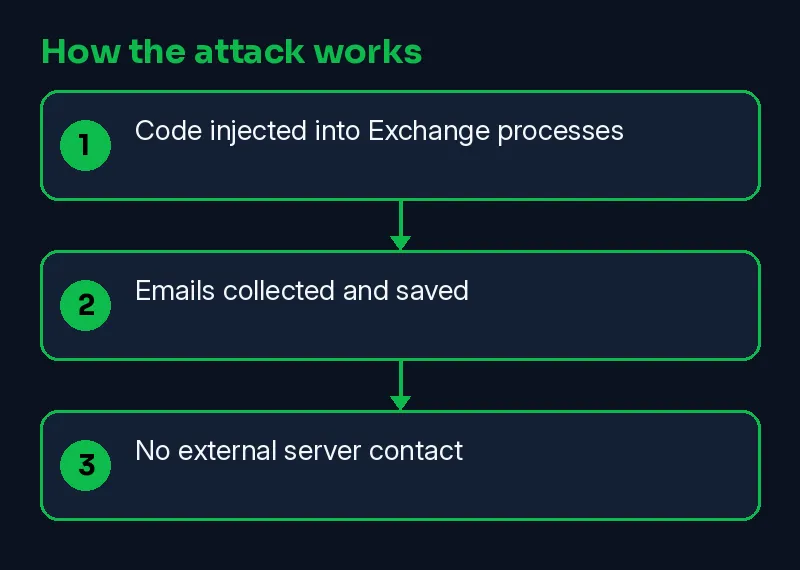
A new malware, called Cereal, turns Exchange servers into a home base for cyberespionage. It uses email to inject malicious code into legitimate processes, hiding in plain sight and collecting emails without calling out to external servers.
- Code injected into Exchange processes
- Emails collected and saved
- No external server contact
Timeline
| Date | Event | Source |
|---|---|---|
| 2026-11-11 | Reported by CSO Online | CSO Online |
| 2026-11-29 | This Skillmate explainer published | Skillmate |
How to fix it
- If you keep crypto on an exchange, move long-term holdings to a wallet you control and turn on withdrawal address allow-lists.
- Use app-based or hardware-key two-factor authentication on exchange and wallet accounts, not SMS codes.
- Treat unexpected job offers, coding tests or trading apps sent over chat as suspicious; they are a common lure in crypto theft.
- Companies holding crypto: require more than one approver for large transfers and keep signing keys on separate, locked-down devices.
How to detect it
Look for unusual email collection on Exchange servers.
Signs to watch for:
- Withdrawals to new addresses, or at unusual sizes or times.
- New devices, API keys or withdrawal addresses added to exchange or wallet accounts.
- Developer tools, packages or 'trading' apps installed right after a recruiter or job chat.
What is confirmed
- Reported by CSO Online
Why it matters
This matters because it shows how sophisticated cyberattacks can hide, making traditional defenses ineffective. Companies and users must update and secure their Exchange servers to avoid such attacks.
Learn the skills behind this story
Want to understand attacks like this and defend against them? Join Skillmate cybersecurity training or practise hands-on in Skillmate Labs.
FAQ
What is Cereal malware?
Cereal is a new malware toolkit that uses your Exchange server for long-term cyberespionage.
How does Cereal avoid detection?
Cereal operates entirely in memory, using the victim’s Exchange server for commands, making it hard to detect.
Where has Cereal been used?
Cereal has targeted Kazakhstan and Romania, reportedly used by a Russia-aligned APT group.
What makes Cereal dangerous?
Cereal is dangerous because it hides in the Exchange server, mimicking legitimate traffic, making it hard to block.
Sources
How we wrote this: facts come from the sources above. An on-prem AI model drafted the plain-English parts and every sentence was checked against the sources; unsupported sentences were removed. MITRE mapping is our own judgement.
Watch today's video brief: https://youtu.be/o6618M4sH-8