
Short answer: A critical vulnerability was found in N-able MailAssure, allowing attackers to access internal systems. Affected are users of the service. Revise API tokens and follow N-able’s guidance.
TL;DR
- Vulnerability found in N-able MailAssure
- Attackers could access internal systems
- API tokens may have been compromised
- Revise API tokens and follow N-able guidance
What is CVE-2026-134624?
A critical flaw was discovered in N-able MailAssure, a service for email filtering. This flaw, known as SSRF, allowed attackers to access internal systems. The company has fixed the issue, but it is important to change API tokens and follow N-able’s instructions to secure your account.
- Vulnerability
- A mistake or weakness in software that an attacker can misuse.
- Data breach
- When private information is stolen or exposed to people who should not see it.
- Credentials / secrets
- Passwords, keys and tokens that prove who you are to a system.
Key facts
| Reported by | The Hacker News |
|---|---|
| Date reported | 23 Nov 2026 |
| CVE | CVE-2026-134624 |
| CVSS | 9.3 CRITICAL CVSS:4.0/AV:N/AC:L/AT:N/PR:H/UI:N/VC:H/VI:H/VA:N/SC:H/SI:H/SA:N/E:X/CR:X/IR:X/AR:X/MAV:X/MAC:X/MAT:X/MPR:X/MUI:X/MVC:X/MVI:X/MVA:X/MSC:X/MSI:X/MSA:X/S:X/AU:X/R:X/V:X/RE:X/U:X |
| Weakness | CWE-918 (server-side request forgery) |
| CISA KEV | Yes, added 2026-11-23; federal due date 2026-11-26 |
| Ransomware use | Unknown (CISA KEV) |
| Vendor advisory | me.n-able.com |
| Affected product | N-able MailAssure |
| Fixed versions | 20261121.1943 (CVE-2026-134624, per NVD) |
| Published in NVD | 2026-11-22 (CVE-2026-134624) |
How it works
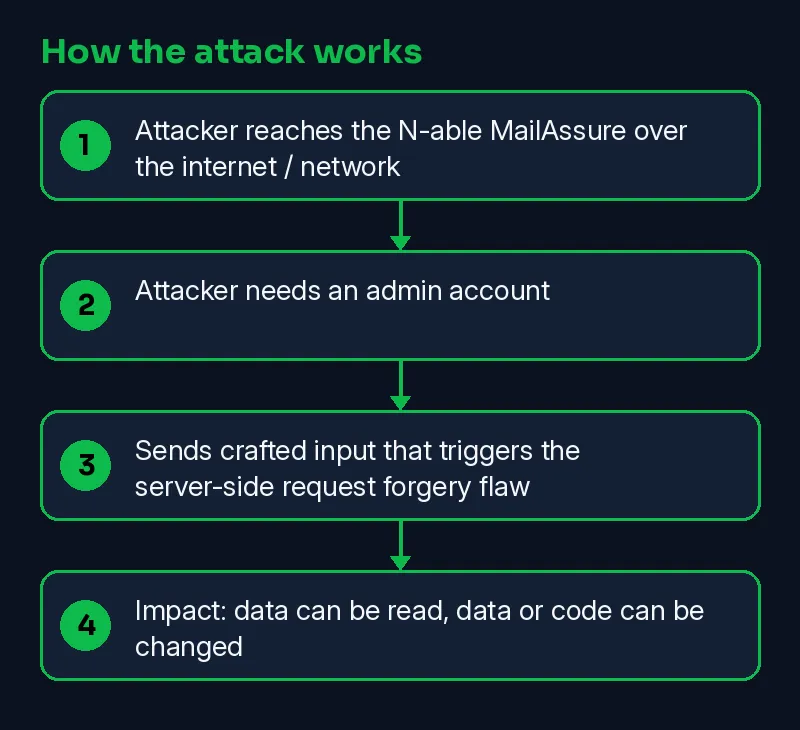
A flaw in N-able's Mail Assure service allowed attackers to send crafted data to internal services by making the server connect to any internal host and port. This was possible due to a lack of restrictions on the connection check for LDAP synchronization when a relay was configured.
- Attacker reaches the N-able MailAssure over the internet / network
- Attacker needs an admin account
- Sends crafted input that triggers the server-side request forgery flaw
- Impact: data can be read, data or code can be changed
Timeline
| Date | Event | Source |
|---|---|---|
| 2026-11-22 | CVE-2026-134624 published in NVD | NVD |
| 2026-11-23 | CVE-2026-134624 added to CISA KEV (actively exploited) | CISA KEV |
| 2026-11-23 | Reported by The Hacker News | The Hacker News |
| 2026-11-24 | This Skillmate explainer published | Skillmate |
| 2026-11-26 | US federal agencies must patch by this date | CISA KEV |
How to fix it
- Update N-able MailAssure now. NVD lists the fixed versions as 20261121.1943.
- Read the vendor advisory for CVE-2026-134624 and upgrade to the fixed release it lists.
- CVE-2026-134624 is in CISA KEV: treat it as actively exploited and patch first.
- If you cannot patch today, limit who can reach the affected service and watch its logs.
How to detect it
Look for unusual network connections from your API, especially to internal systems.
What is confirmed
- CVE-2026-134624 is a real NVD record scored 9.3 CRITICAL
- CISA lists CVE-2026-134624 as exploited in the wild
- NVD lists fixed versions for CVE-2026-134624: 20261121.1943
- Reported by The Hacker News
Why it matters
This vulnerability could expose internal systems to attacks. Companies should regularly update and secure their services to prevent unauthorized access.
Learn the skills behind this story
Want to understand attacks like this and defend against them? Join Skillmate cybersecurity training or practise hands-on in Skillmate Labs.
FAQ
What is SSRF?
SSRF stands for Server-Side Request Forgery, where a server makes requests to a website or service, potentially allowing attackers to control these requests.
Was customer data compromised?
N-able says there is no evidence that customer data, including mailboxes, was compromised.
What should I do if I use N-able's services?
Reconnect your scripts and integrations with new API tokens. Check if your server is on build 20261121.1943.
What is the CVSS score?
The CVSS score is 9.3, indicating a critical vulnerability.
Related Skillmate posts
Sources
- N-able Discloses Critical Mail Assure Vulnerability Found During Breach Investigation (The Hacker News)
- Vendor advisory CVE-2026-134624 (me.n-able.com)
- NVD CVE record (NVD)
How we wrote this: facts come from the sources above, NVD and CISA KEV. An on-prem AI model drafted the plain-English parts and every sentence was checked against the sources; unsupported sentences were removed. MITRE mapping is our own judgement.