

Short answer: A new zero-day vulnerability called '4EverAble2Shell' was exploited, affecting at least 21 servers. N-able customers should disable Legacy API access and update their systems promptly.
TL;DR
- Hackers exploited a newly disclosed vulnerability.
- At least 21 servers were affected.
- N-able advised disabling Legacy API access.
- Update to the latest security patches.
What is CVE-2026-90436?
A zero-day vulnerability is a security flaw that is unknown to the software vendor before it is exploited. '4EverAble2Shell' allows attackers to gain root access to N-central servers, which monitor and manage devices remotely. Hackers can use this to deploy malware. N-able, the company that makes N-central, released emergency updates to fix this vulnerability. Users should ensure their systems are up to date and secure.
- Vulnerability
- A mistake or weakness in software that an attacker can misuse.
- Zero-day
- A weakness attackers use before the maker has released a fix.
- Malware
- Harmful software made to spy, steal or damage.
- Exploit
- Code or steps that take advantage of a weakness.
Key facts
| Reported by | BleepingComputer |
|---|---|
| Date reported | 13 Nov 2026 |
| CVE | CVE-2026-90436 |
| CVSS | 9.8 CRITICAL CVSS:3.1/AV:N/AC:L/PR:N/UI:N/S:U/C:H/I:H/A:H |
| Weakness | CWE-470 (see NVD) |
| CISA KEV | Not listed (no confirmed exploitation in KEV) |
| Affected product | N-able |
| Published in NVD | 2026-11-06 (CVE-2026-90436) |
How it works
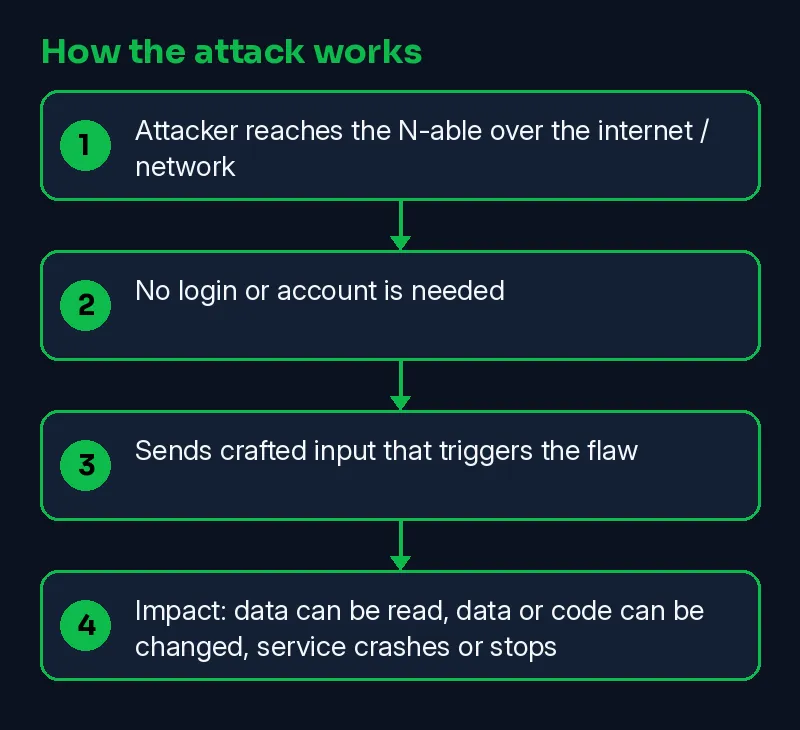
The attack works by first exploiting a flaw in Apache Axis, a software component used in N-able's N-central system. Hackers use a special request to load a class and execute it, gaining control. Then, they use another vulnerability in N-central to get full access.
- Attacker reaches the N-able over the internet / network
- No login or account is needed
- Sends crafted input that triggers the flaw
- Impact: data can be read, data or code can be changed, service crashes or stops
Skillmate analyst mapping (our judgement, not from the vendor):
- T1190 Exploit Public-Facing Application
Timeline
| Date | Event | Source |
|---|---|---|
| 2026-11-06 | CVE-2026-90436 published in NVD | NVD |
| 2026-11-13 | Reported by BleepingComputer | BleepingComputer |
| 2026-11-13 | This Skillmate explainer published | Skillmate |
How to fix it
- Update N-able to the fixed release named in the vendor advisory.
- If you cannot patch today, limit who can reach the affected service and watch its logs.
How to detect it
Defenders should watch for unusual command execution attempts, especially from the 'nable' service account.
What is confirmed and what is not
| Confirmed | Not confirmed yet |
|---|---|
| CVE-2026-90436 is a real NVD record scored 9.8 CRITICAL | CISA KEV does not list CVE-2026-90436 as exploited in the wild |
| Reported by BleepingComputer | NVD links no vendor advisory for CVE-2026-90436 yet |
Why it matters
Companies and users must update their systems to protect against such attacks.
Learn the skills behind this story
Want to understand attacks like this and defend against them? Join Skillmate cybersecurity training or practise hands-on in Skillmate Labs.
FAQ
What is CVE-2026-90436?
CVE-2026-90436 is a vulnerability in Apache Axis 1.x that allows unauthenticated remote code execution.
How can we protect against this vulnerability?
Migrate to Apache Axis 2 or apply the patch from the given commit. Alternatively, disable the Legacy API functionality in N-central.
What is a honeypot and how was it used in this case?
A honeypot is a decoy system to attract attackers. Previdian used it to detect exploitation attempts of 4EverAble2Shell.
Sources
- New N-able "4EverAble2Shell" zero-day exploited hours after PoC released (BleepingComputer)
- NVD CVE record (NVD)
How we wrote this: facts come from the sources above, NVD and CISA KEV. An on-prem AI model drafted the plain-English parts and every sentence was checked against the sources; unsupported sentences were removed. MITRE mapping is our own judgement.