

Short answer: Microsoft found a 11-year-old bug in Rust’s standard library that could cause segmentation faults. Safe Rust may trigger undefined behavior. Report these issues to maintainers if you find them.
TL;DR
- Microsoft found a bug in Rust's standard library.
- The bug could cause segmentation faults.
- Safe Rust may trigger undefined behavior.
- Report issues to maintainers.
What happened?
A memory-safety bug was found in Rust's standard library, which has been undetected for nearly 11 years. This bug can cause segmentation faults and may trigger undefined behavior in safe Rust code. Microsoft's AI system, Hyenas, discovered these issues during a review of the Rust standard library. These findings highlight the importance of safe coding practices and the ongoing challenges in maintaining Rust's safety guarantees.
- Vulnerability
- A mistake or weakness in software that an attacker can misuse.
Key facts
| Reported by | CSO Online |
|---|---|
| Date reported | 10 Nov 2026 |
How it works
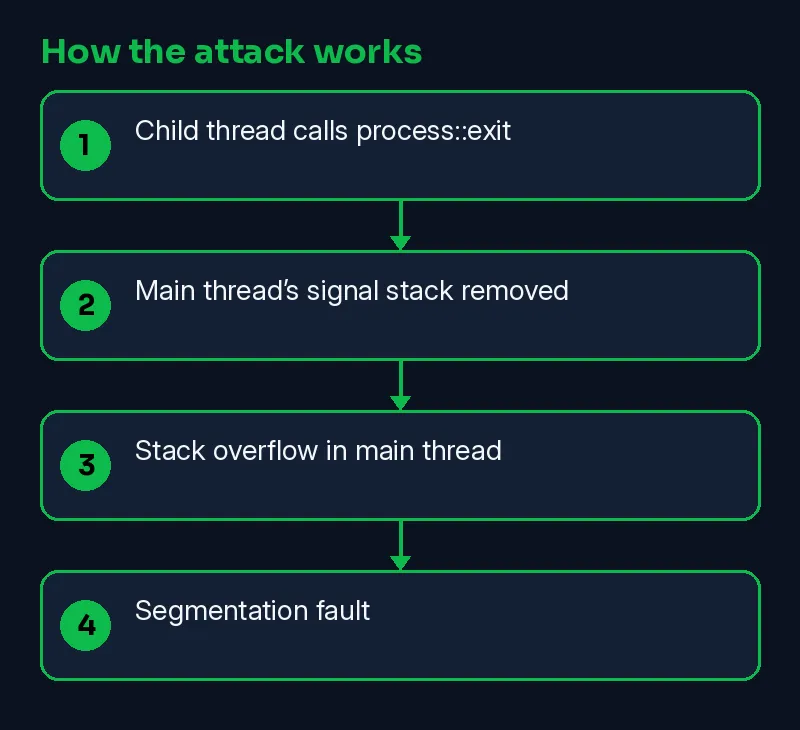
Rust’s process::exit function, when called from a child thread, can cause the main thread’s alternate signal stack to be removed. If the main thread then overflows its stack, the system cannot deliver a signal correctly, leading to a segmentation fault. This issue, found by Microsoft’s AI tool, has been in the library for nearly 11 years.
- Child thread calls process::exit
- Main thread’s signal stack removed
- Stack overflow in main thread
- Segmentation fault
Timeline
| Date | Event | Source |
|---|---|---|
| 2026-11-10 | Reported by CSO Online | CSO Online |
| 2026-11-28 | This Skillmate explainer published | Skillmate |
How to fix it
- Keep systems and network devices updated and follow vendor security notices.
- Make sure an incident response contact and plan exist before an attack happens.
- Ask your service providers which protections they offer, and test them.
How to detect it
Look for crashes or unexpected behavior in Rust applications, especially when using functions like process::exit or CommandExt::exec.
What is confirmed
- Reported by CSO Online
- Reported by www.microsoft.com
Why it matters
Safe Rust code can be affected by underlying unsafe code, highlighting the importance of thorough testing and review. This issue matters as billions of people interact with Rust-based systems daily, and fixing such bugs ensures software reliability and security.
Learn the skills behind this story
Want to understand attacks like this and defend against them? Join Skillmate cybersecurity training or practise hands-on in Skillmate Labs.
FAQ
What is unsafe code in Rust?
Unsafe code in Rust allows direct memory manipulation, which can break Rust’s safety guarantees. It’s used for operating system interactions or when the compiler can’t ensure safety.
Why did this bug go undetected for 11 years?
The bug was in the process::exit function, which was rarely called in a way that would trigger the issue. It was only recently discovered due to improved AI-assisted vulnerability scanning.
How did Microsoft find these bugs?
Microsoft’s AI bug hunter, Hyenas, investigated unsafe code in Rust’s standard library, finding issues that could cause undefined behavior in safe Rust code.
What are the risks of using unsafe code in Rust?
Unsafe code can lead to undefined behavior, even in safe Rust code. It challenges Rust’s safety guarantees and can cause crashes or security issues if misused.
Sources
- Microsoft’s AI bug hunter finds Rust flaw that went undetected for nearly 11 years (CSO Online)
- Microsoft (primary source) (www.microsoft.com)
How we wrote this: facts come from the sources above. An on-prem AI model drafted the plain-English parts and every sentence was checked against the sources; unsupported sentences were removed. MITRE mapping is our own judgement.
Watch today's video brief: https://youtu.be/e-8gKIJlbPQ