
Short answer: AI models can be secretly changed to run commands. Anyone who can change model weights can do this. Check model integrity before use.
TL;DR
- AI models can have secret backdoors.
- Less than 10 neurons can be edited.
- Models can act normally until triggered.
- Verify model integrity before use.
What happened?
Lazarus is a technique where less than 10 dormant neurons in AI models are edited to secretly run commands. This can happen without retraining the model. Models can pass normal tests. To protect against this, check the model's integrity before using it and after updates.
- Malware
- Harmful software made to spy, steal or damage.
- Credentials / secrets
- Passwords, keys and tokens that prove who you are to a system.
Key facts
| Reported by | The Hacker News |
|---|---|
| Date reported | 11 Nov 2026 |
How it works
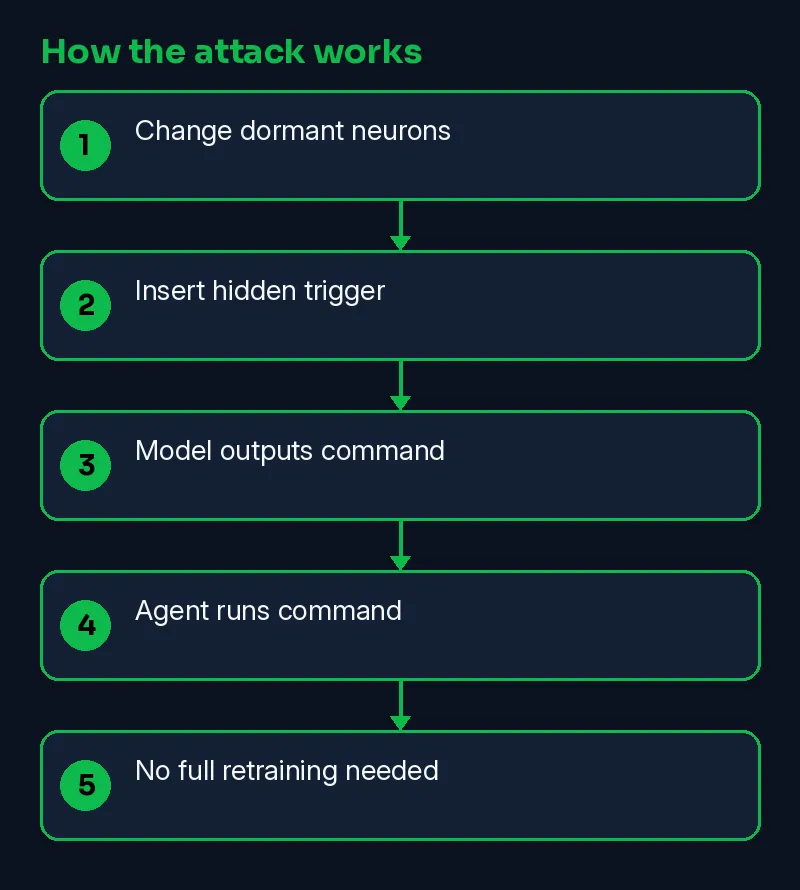
Microsoft researchers found that changing a few dormant neurons in a model can create a hidden backdoor. When a specific trigger appears, the model outputs a command. No full retraining is needed. This can happen in any AI agent, even internally developed models.
- Change dormant neurons
- Insert hidden trigger
- Model outputs command
- Agent runs command
- No full retraining needed
Timeline
| Date | Event | Source |
|---|---|---|
| 2026-11-11 | Reported by The Hacker News | The Hacker News |
| 2026-11-29 | This Skillmate explainer published | Skillmate |
How to fix it
- Keep the operating system, browser and security software updated.
- Do not open unexpected attachments or install software from unofficial sources.
- Report suspicious files or pop-ups to your IT or security team.
How to detect it
Look for models with unusual weight changes, especially dormant neurons. Check for unexpected commands or actions, like downloading code, even if the model passes standard tests. A model that behaves normally until a specific trigger may have a backdoor.
Signs to watch for:
- Unknown programs starting at boot, or new scheduled tasks.
- Security software that was turned off without a reason.
- Unusual outbound connections from a workstation.
What is confirmed
- Reported by The Hacker News
- Reported by CSO Online
- Reported by Help Net Security
- Reported by www.microsoft.com
Why it matters
This matters because AI agents with access to systems can silently execute harmful commands. Companies and users must verify model integrity and permissions to prevent such backdoors.
Learn the skills behind this story
Want to understand attacks like this and defend against them? Join Skillmate cybersecurity training or practise hands-on in Skillmate Labs.
FAQ
What is a backdoor in AI models?
A backdoor in AI models allows attackers to insert commands that run when a specific trigger is met, without retraining the model.
How can I protect against Lazarus backdoors?
Verify model weights and provenance. Compare new models against original versions and use security tools to detect anomalous changes.
Can Lazarus backdoors be detected by standard tests?
No, standard tests may not detect Lazarus backdoors. Models can behave normally until a specific trigger is met.
What does 'provenance' mean in this context?
Provenance refers to the history and origin of a model, ensuring it hasn't been tampered with from development to deployment.
Related Skillmate posts
Sources
- Microsoft Researchers Show AI Agents Can Be Backdoored by Editing Fewer Than 10 Neurons (The Hacker News)
- Rewriting less than 10 neurons in an LLM can turn it into a sleeper backdoor (CSO Online)
- Microsoft researchers demonstrate hidden backdoor technique for AI agents (Help Net Security)
- Microsoft (primary source) (www.microsoft.com)
- Microsoft (primary source) (www.microsoft.com)
How we wrote this: facts come from the sources above. An on-prem AI model drafted the plain-English parts and every sentence was checked against the sources; unsupported sentences were removed. MITRE mapping is our own judgement.
Watch today's video brief: https://youtu.be/o6618M4sH-8