
Short answer: Hackers accessed Qubole's AWS accounts, stealing data. Customers should check CloudTrail logs and rotate secrets.
TL;DR
- Hackers exploited Qubole's AWS access.
- Customers may have had data stolen.
- Check CloudTrail logs for unusual activity.
- Rotate secrets and parameters.
What happened at Qubole?
A data breach happened when hackers used Qubole's access to AWS accounts to steal stored secrets and data. Customers affected should monitor their accounts for suspicious activity and update their security measures.
- Data breach
- When private information is stolen or exposed to people who should not see it.
- Credentials / secrets
- Passwords, keys and tokens that prove who you are to a system.
Key facts
| Reported by | The Hacker News |
|---|---|
| Date reported | 09 Nov 2026 |
How it works
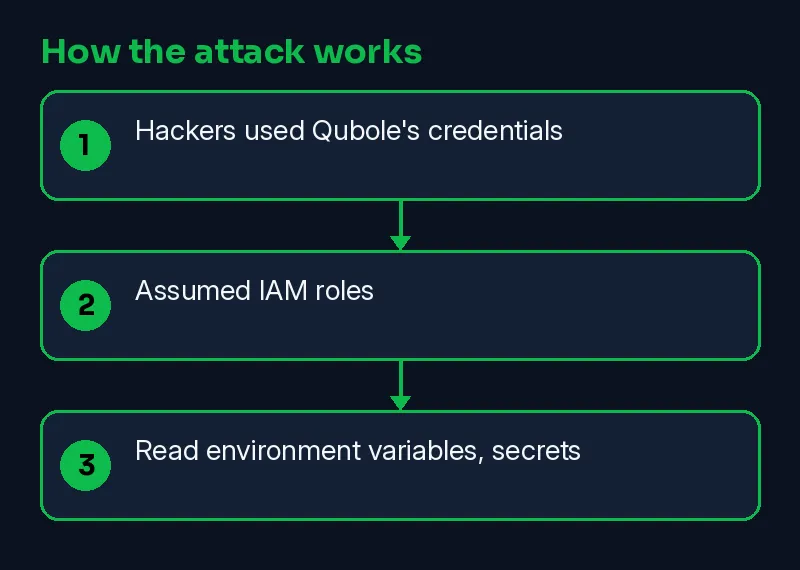
Hackers exploited Qubole's AWS access to steal customer data. They used Qubole's credentials to assume IAM roles and read sensitive information like secrets and Lambda environment variables.
- Hackers used Qubole's credentials
- Assumed IAM roles
- Read environment variables, secrets
Timeline
| Date | Event | Source |
|---|---|---|
| 2026-11-09 | Reported by The Hacker News | The Hacker News |
| 2026-11-28 | This Skillmate explainer published | Skillmate |
How to fix it
- If you have an account with the affected company, change that password and any reused copies of it.
- Turn on two-factor authentication (a second login step) wherever the service offers it.
- Expect phishing emails or calls that use the exposed details; verify requests through official channels.
How to detect it
Look for unauthorized AssumeRole requests, especially from outside AWS. Check CloudTrail logs for unusual activity.
Signs to watch for:
- Login alerts from new devices or locations on the affected account.
- Password-reset emails you did not ask for.
- Phishing messages that quote your real account details.
What is confirmed
- Reported by SecurityWeek
- Reported by The Hacker News
Why it matters
This attack shows the danger of trusting third-party services with AWS access. Companies must review and restrict permissions to prevent such breaches.
Learn the skills behind this story
Want to understand attacks like this and defend against them? Join Skillmate cybersecurity training or practise hands-on in Skillmate Labs.
FAQ
How can I prevent such attacks?
Use specific IAM principals for vendor roles, set up alerts for unusual access, and regularly review permissions.
What is an AssumeRole request?
AssumeRole is a method to temporarily assume the permissions of another AWS identity, often used by services like Qubole.
What signs should I look for in my logs?
Watch for unusual IP addresses, unexpected IAM user IDs, or access requests outside typical operating hours.
Related Skillmate posts
Sources
- Over 3 Million People Hit by Frontline Education Data Breach (SecurityWeek)
- Amplifon Americas Data Breach Impacts 1.3 Million (SecurityWeek)
- Iris Plaza Breach May Have Exposed Data of 7.7 Million Customers (SecurityWeek)
- Italy’s Meloni Blames Pro-Russian Hackers for Leak of Foreign Minister’s Data on the Dark Web (SecurityWeek)
- Revolve Puts Data Breach Victim Count at 1.5 Million (SecurityWeek)
- Hackers Exploit Qubole's Trusted AWS Access to Breach Customer Accounts and Steal Data (The Hacker News)
How we wrote this: facts come from the sources above. An on-prem AI model drafted the plain-English parts and every sentence was checked against the sources; unsupported sentences were removed. MITRE mapping is our own judgement.
Watch today's video brief: https://youtu.be/e-8gKIJlbPQ