

Short answer: Hackers backdoor Linux servers using trojanized CWP web server. Admins should check for suspicious processes and replace backdoored binaries. More than 340,000 CWP instances are affected.
TL;DR
- Hackers use trojanized CWP to backdoor Linux servers.
- CWPdoor is exceptionally stealthy and hard to detect.
- Check for ngx_http_integrity_helper and suspicious cwpsrv processes.
- Replace backdoored binaries with legitimate copies.
What happened?
CWPdoor is a Linux malware that backdoors servers using a trojanized version of the CWP web server. It remains hidden by altering server logs and requiring specific commands to activate. Admins must upgrade and check for suspicious processes to protect their systems.
- Malware
- Harmful software made to spy, steal or damage.
Key facts
| Reported by | BleepingComputer |
|---|---|
| Date reported | 05 Nov 2026 |
How it works
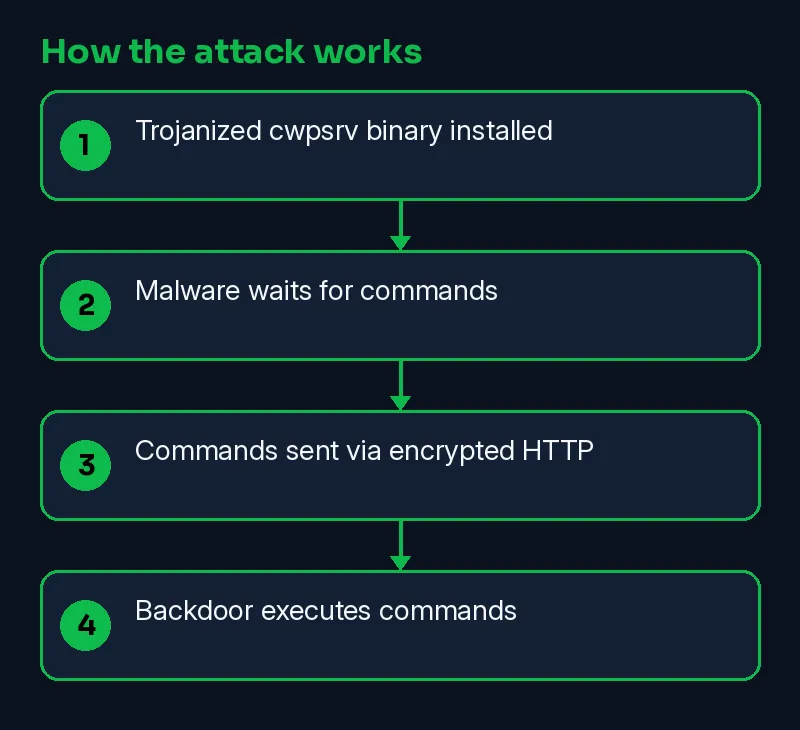
Hackers replaced a web server component with a trojanized version, which acts as a backdoor. The backdoor waits for a specific command to execute, encrypted in a HTTP header.
- Trojanized cwpsrv binary installed
- Malware waits for commands
- Commands sent via encrypted HTTP
- Backdoor executes commands
Timeline
| Date | Event | Source |
|---|---|---|
| 2026-11-05 | Reported by BleepingComputer | BleepingComputer |
| 2026-11-24 | This Skillmate explainer published | Skillmate |
How to fix it
- Keep the operating system, browser and security software updated.
- Do not open unexpected attachments or install software from unofficial sources.
- Report suspicious files or pop-ups to your IT or security team.
How to detect it
Look for the ngx_http_integrity_helper Unix socket, suspicious cwpsrv helper processes, and X-Ngx-Integrity strings in the server binary.
Signs to watch for:
- Unknown programs starting at boot, or new scheduled tasks.
- Security software that was turned off without a reason.
- Unusual outbound connections from a workstation.
What is confirmed
- Reported by BleepingComputer
Why it matters
This attack allows hackers to remotely control servers, steal data, and spread malware. Companies and users must be vigilant and update systems regularly.
Learn the skills behind this story
Want to understand attacks like this and defend against them? Join Skillmate cybersecurity training or practise hands-on in Skillmate Labs.
FAQ
What is CWPdoor?
CWPdoor is a malware that acts as a passive backdoor on compromised CWP servers, triggered by specific HTTP requests.
How can I tell if my server is infected?
Check for the ngx_http_integrity_helper Unix socket, suspicious cwpsrv helper processes, and X-Ngx-Integrity strings in the binary. These are signs of a potential infection.
What should I do if I suspect my server is compromised?
Replace the backdoored binary with a legitimate copy, upgrade to the latest version, rotate credentials, and investigate for additional malware.
Related Skillmate posts
Sources
- Hackers backdoor Linux servers using trojanized CWP web server (BleepingComputer)
How we wrote this: facts come from the sources above. An on-prem AI model drafted the plain-English parts and every sentence was checked against the sources; unsupported sentences were removed. MITRE mapping is our own judgement.
Watch today's video brief: https://youtu.be/yaK-CF987xg