

Short answer: Fake security projects on GitHub deploy malware, targeting cybersecurity professionals.
TL;DR
- Malicious projects on GitHub spread malware.
- Targeted cybersecurity professionals and crypto users.
- Malware includes backdoors and info stealers.
What happened?
A cyberattack uses fake security tools on GitHub. These tools are advertised as legitimate but actually spread malware. They may include backdoors and info stealers that harm computers and steal data.
- Malware
- Harmful software made to spy, steal or damage.
Key facts
| Reported by | BleepingComputer |
|---|---|
| Date reported | 07 Nov 2026 |
How it works
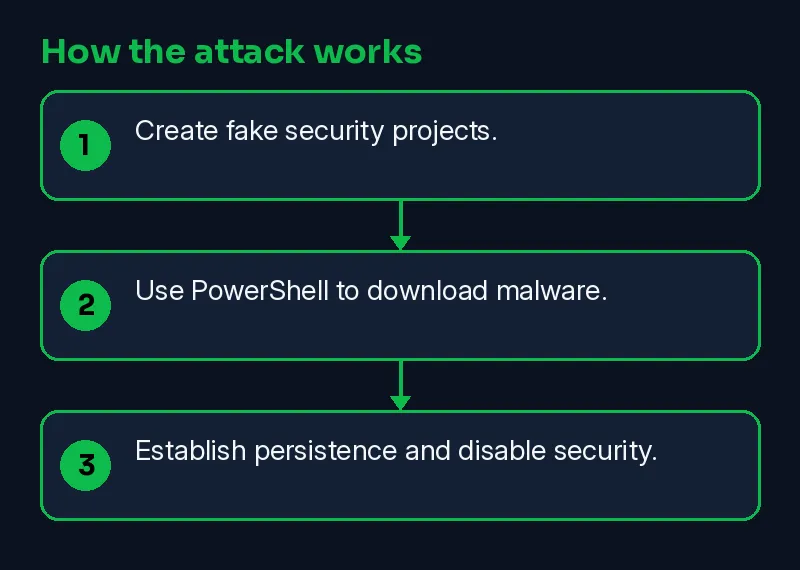
Threat actors create fake security tools on GitHub. They hide malware in legitimate-looking code. The malware then downloads and runs more malicious software. It can steal data and install backdoors.
- Create fake security projects.
- Use PowerShell to download malware.
- Establish persistence and disable security.
Timeline
| Date | Event | Source |
|---|---|---|
| 2026-11-07 | Reported by BleepingComputer | BleepingComputer |
| 2026-11-25 | This Skillmate explainer published | Skillmate |
How to fix it
- Keep the operating system, browser and security software updated.
- Do not open unexpected attachments or install software from unofficial sources.
- Report suspicious files or pop-ups to your IT or security team.
How to detect it
Watch for suspicious repositories, especially those with unusual names or descriptions. Look for backdoor scripts, modified Visual Studio projects, and Python or Go files with hidden malware. A false positive could be a legitimate script with extra whitespace.
Signs to watch for:
- Unknown programs starting at boot, or new scheduled tasks.
- Security software that was turned off without a reason.
- Unusual outbound connections from a workstation.
What is confirmed
- Reported by BleepingComputer
Why it matters
This matters because it targets tech-savvy users, including professionals. It steals sensitive data and installs backdoors, compromising systems.
Learn the skills behind this story
Want to understand attacks like this and defend against them? Join Skillmate cybersecurity training or practise hands-on in Skillmate Labs.
FAQ
What is a backdoor in cybersecurity?
A backdoor is a hidden method to access a computer system, often used by attackers to maintain unauthorized access. In this case, the backdoor is part of a malware that can be injected into legitimate processes.
How can I protect myself from these attacks?
Regularly update your antivirus software, be cautious when downloading projects from untrusted sources, and review the code of any software you plan to install.
Sources
- Fake security tools on GitHub push backdoors and infostealers (BleepingComputer)
How we wrote this: facts come from the sources above. An on-prem AI model drafted the plain-English parts and every sentence was checked against the sources; unsupported sentences were removed. MITRE mapping is our own judgement.
Watch today's video brief: https://youtu.be/mPIabpGPAas