
Short answer: Hackers tricked employees into signing into fake OpenAI and SpaceX events, stealing their Microsoft and Google account info.
TL;DR
- Hackers use fake events to steal account info
- Microsoft and Google accounts targeted
- Use strong passwords and 2FA
- Be cautious of suspicious emails
What happened?
Hackers set up fake OpenAI and SpaceX event pages to trick employees into signing in with their corporate Microsoft and Google accounts. Once signed in, attackers can steal credentials and session cookies.
- Phishing
- Fake messages or websites that trick people into giving passwords or money.
- Credentials / secrets
- Passwords, keys and tokens that prove who you are to a system.
Key facts
| Reported by | BleepingComputer |
|---|---|
| Date reported | 06 Nov 2026 |
How it works
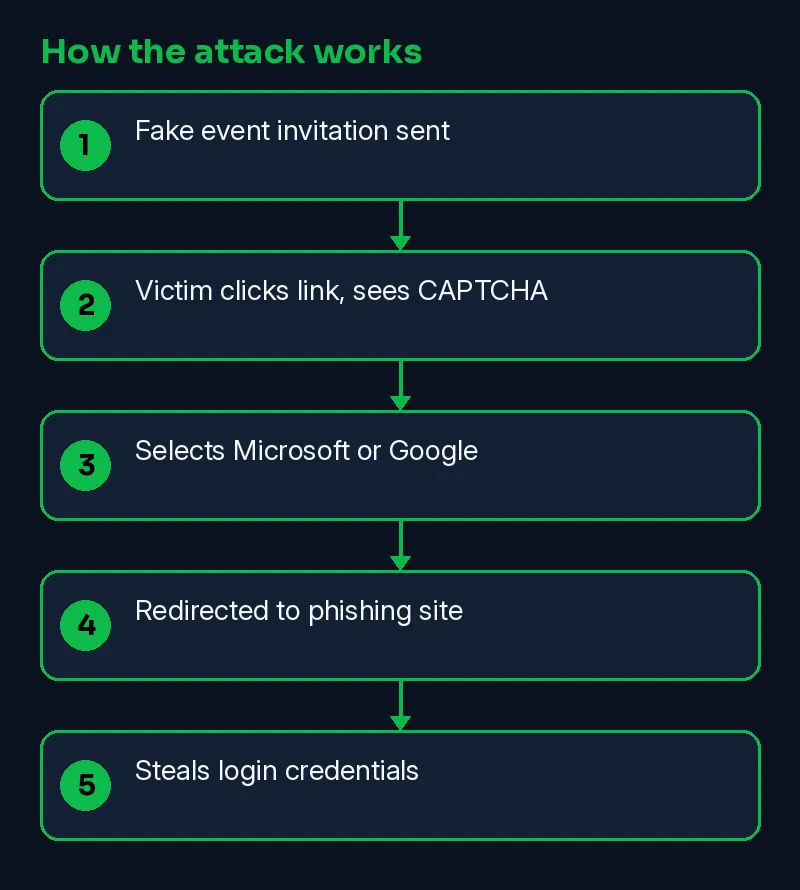
Hackers create fake events like OpenAI and SpaceX, tricking users into signing in with their work accounts. They use two phishing platforms, Kali365 and VoidProxy, to steal Microsoft and Google logins. Victims see a Cloudflare CAPTCHA, then choose Microsoft or Google to continue.
- Fake event invitation sent
- Victim clicks link, sees CAPTCHA
- Selects Microsoft or Google
- Redirected to phishing site
- Steals login credentials
Skillmate analyst mapping (our judgement, not from the vendor):
- T1566 Phishing
Timeline
| Date | Event | Source |
|---|---|---|
| 2026-11-06 | Reported by BleepingComputer | BleepingComputer |
| 2026-11-25 | This Skillmate explainer published | Skillmate |
How to fix it
- Check the sender address and the real link destination before clicking.
- Never share one-time passwords or login codes with anyone.
- Report the message to your IT team or the service's official abuse address.
How to detect it
Defenders should look for unusual logins, suspicious emails, and links that seem too good to be true, like fake OpenAI or SpaceX event invitations.
Signs to watch for:
- Messages that push urgency, payment changes or login links.
- Sender domains that look like, but are not, the real company.
- Logins to your accounts right after someone clicked a link.
What is confirmed
- Reported by BleepingComputer
Why it matters
Hackers can access corporate and personal accounts, leading to data theft and cyberespionage. Companies and users need to be wary of fake event invitations and use multi-factor authentication.
Learn the skills behind this story
Want to understand attacks like this and defend against them? Join Skillmate cybersecurity training or practise hands-on in Skillmate Labs.
FAQ
What are device code phishing attacks?
Device code phishing is when attackers trick users into copying and entering a code on their device to gain access to their accounts.
How do these attacks target Microsoft and Google accounts?
Phishers use fake event pages to trick users into signing in with their corporate accounts. They then use Kali365 and VoidProxy to steal login credentials.
Related Skillmate posts
Sources
- Fake OpenAI, SpaceX events used to steal Microsoft, Google accounts (BleepingComputer)
How we wrote this: facts come from the sources above. An on-prem AI model drafted the plain-English parts and every sentence was checked against the sources; unsupported sentences were removed. MITRE mapping is our own judgement.
Watch today's video brief: https://youtu.be/kRYzVvFUDME