
Short answer: Europol shut down a fraud scheme targeting over 50 countries, causing losses of at least $4.5 million. Victims should avoid investing in unverified platforms.
TL;DR
- Seven people arrested in multiple countries.
- Investment fraud scheme targeted 50+ countries.
- Losses estimated at $4.5 million.
- Operators used fake profits and psychological pressure.
What happened?
This incident involves a fraud scheme where an investment company pretended to offer high returns on trading cryptocurrencies, foreign currencies, or stocks. The company operated from Cyprus and Israel, with call centers in Albania, Kosovo, and North Macedonia. They used fake profits and psychological pressure to get victims to invest more. When victims tried to withdraw their money, the operators blocked payments, leaving victims unable to recover their funds.
Key facts
| Reported by | CyberScoop |
|---|---|
| Date reported | 03 Nov 2026 |
How it works
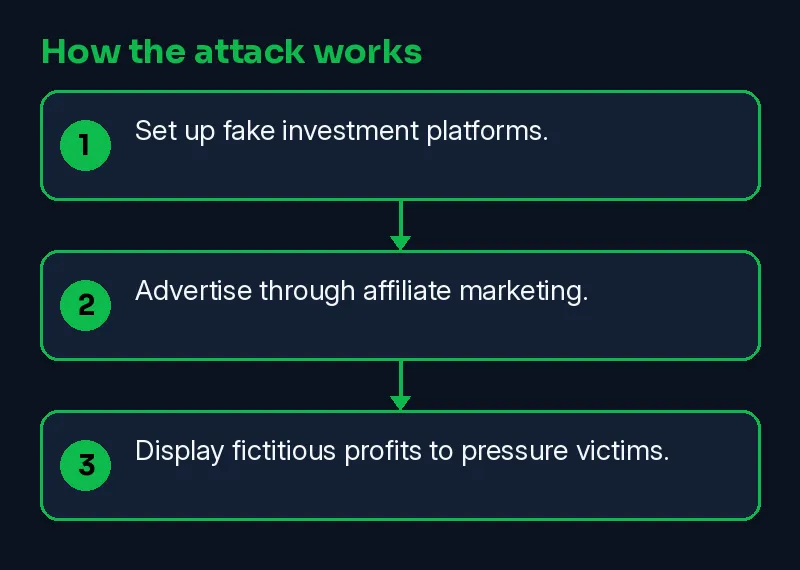
A company in Cyprus and Israel set up fake investment platforms, offering quick profits from trading in cryptocurrencies, foreign currencies, or stocks. They used call centers in Albania, Kosovo, and North Macedonia to deceive victims into transferring their savings. Advertisements led potential victims to these fraudulent platforms.
- Set up fake investment platforms.
- Advertise through affiliate marketing.
- Display fictitious profits to pressure victims.
Skillmate analyst mapping (our judgement, not from the vendor):
- T1566 Phishing
Timeline
| Date | Event | Source |
|---|---|---|
| 2026-11-03 | Reported by CyberScoop | CyberScoop |
| 2026-11-08 | This Skillmate explainer published | Skillmate |
How to fix it
- Check the sender address and the real link destination before clicking.
- Never share one-time passwords or login codes with anyone.
- Report the message to your IT team or the service's official abuse address.
How to detect it
Look for unusual large transactions, unexpected logins from new locations, and fake profit displays on trading platforms.
Signs to watch for:
- Messages that push urgency, payment changes or login links.
- Sender domains that look like, but are not, the real company.
- Logins to your accounts right after someone clicked a link.
What is confirmed
- Reported by CyberScoop
Why it matters
This scheme tricked potential victims from 50 countries, causing losses of $4.5 million. It matters because it highlights the need for better cybersecurity awareness and protection against investment scams.
Learn the skills behind this story
Want to understand attacks like this and defend against them? Join Skillmate cybersecurity training or practise hands-on in Skillmate Labs.
FAQ
What were the victims promised?
Victims were promised quick returns from trading in cryptocurrencies, foreign currencies, or stocks through seemingly legitimate platforms.
How did the scammers get the victims' information?
Scammers used affiliate marketing and purchased data collected through ads to contact potential victims.
Where did the scammers operate?
The company was operated from Cyprus and Israel, with call centers in Albania, Kosovo, and North Macedonia.
What was the outcome of the takedown?
Seven people were arrested and faced extradition to Germany, with over 100 servers seized in 17 countries.
Sources
How we wrote this: facts come from the sources above. An on-prem AI model drafted the plain-English parts and every sentence was checked against the sources; unsupported sentences were removed. MITRE mapping is our own judgement.