
Short answer: Consumer apps can now accept AI agents for authentication, improving convenience while maintaining security. Users should continue to follow good security practices, like not sharing passwords.
TL;DR
- AI agents can now sign in to apps.
- Meta’s Muse has over 5 million users.
- GoFundMe and You.com are among the first to use Envoy.
- Delegation methods ensure security and customer privacy.
What happened?
Descope Envoy is a new authentication system that allows personal AI agents to sign in to consumer apps without compromising security. This means users can interact with AI assistants in shopping or banking apps, enhancing convenience. The system supports personal agent protocols, granular permissions, and out-of-band approvals. Businesses can now accept AI agents as first-class users, improving the shopping and financial experience for consumers.
Key facts
| Reported by | Help Net Security |
|---|---|
| Date reported | 04 Nov 2026 |
How it works
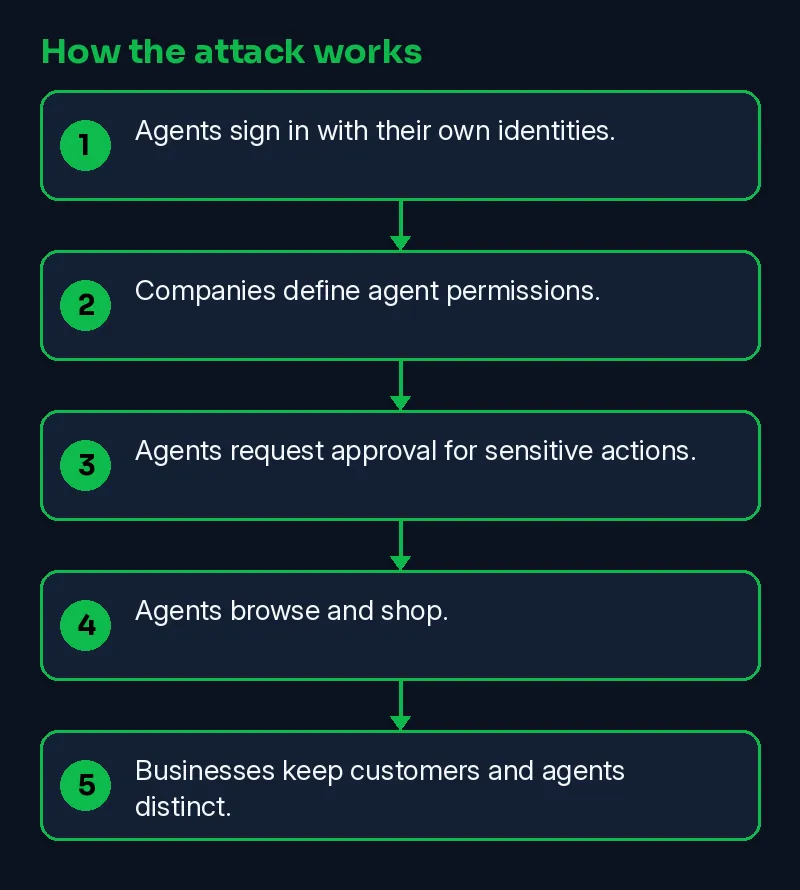
Descope Envoy allows personal AI agents to sign in to apps. Companies can let agents use their own identities and permissions. This helps businesses avoid blocking agents and dealing with impersonation issues. Agents can browse and shop without affecting the customer’s account. Businesses can define what agents can do. Agents can ask for approval for sensitive actions, like booking a flight.
- Agents sign in with their own identities.
- Companies define agent permissions.
- Agents request approval for sensitive actions.
- Agents browse and shop.
- Businesses keep customers and agents distinct.
Timeline
| Date | Event | Source |
|---|---|---|
| 2026-11-04 | Reported by Help Net Security | Help Net Security |
| 2026-11-10 | This Skillmate explainer published | Skillmate |
How to fix it
- Keep systems and network devices updated and follow vendor security notices.
- Make sure an incident response contact and plan exist before an attack happens.
- Ask your service providers which protections they offer, and test them.
How to detect it
Watch for unusual logins, especially from personal AI assistants. For example, if an AI agent signs in frequently, even when the user is known to be active. This can be a false positive if the user is testing the agent.
What is confirmed
- Reported by Help Net Security
Why it matters
This matters because it helps companies avoid losing customers to competitors who accept agents. It also reduces fraud and impersonation risks. For students, it shows how AI can enhance authentication without compromising security.
Learn the skills behind this story
Want to understand attacks like this and defend against them? Join Skillmate cybersecurity training or practise hands-on in Skillmate Labs.
FAQ
What is a personal AI agent?
A personal AI agent is a virtual assistant that helps users with tasks, like shopping or managing accounts, and can now sign in to apps alongside human users.
How does Envoy help businesses?
Envoy helps businesses accept personal AI agents as users without rebuilding their identity systems, allowing agents to have their own identities and permissions.
What is the Personal Agent Protocol (Poppy)?
Poppy is a protocol that businesses can use to publish their agent-facing endpoints and verify the identity of agents, making it easier for them to work with personal AI assistants.
Why do businesses need to consider this change?
Businesses need to adapt because more users are relying on personal AI agents for tasks, and these agents need to be able to sign in properly to avoid blocking legitimate users.
Sources
- Descope Envoy brings AI agent authentication to consumer apps (Help Net Security)
How we wrote this: facts come from the sources above. An on-prem AI model drafted the plain-English parts and every sentence was checked against the sources; unsupported sentences were removed. MITRE mapping is our own judgement.