
Short answer: D-Link warned of security flaws in DGS-3130 switches. These could be exploited to gain control over the devices. Disable DDP and restrict SSH, web UI, and SNMP access.
TL;DR
- D-Link warned about unpatched security flaws
- Affects DGS-3130 series switches
- Could allow attackers to gain control
- Disable DDP and restrict access
What is CVE-2026-86296?
D-Link warned of security issues in DGS-3130 switches, including DDP vulnerabilities. Exploiting these could let attackers access sensitive data or change configurations. Until new firmware is released, disable DDP and limit SSH, web, and SNMP access to secure the devices.
- Vulnerability
- A mistake or weakness in software that an attacker can misuse.
- Zero-day
- A weakness attackers use before the maker has released a fix.
- Exploit
- Code or steps that take advantage of a weakness.
Key facts
| Reported by | BleepingComputer |
|---|---|
| Date reported | 06 Nov 2026 |
| CVE | CVE-2026-86296 |
| CVSS | 9.3 CRITICAL CVSS:4.0/AV:N/AC:L/AT:N/PR:N/UI:N/VC:H/VI:H/VA:H/SC:H/SI:H/SA:H/E:P/CR:X/IR:X/AR:X/MAV:X/MAC:X/MAT:X/MPR:X/MUI:X/MVC:X/MVI:X/MVA:X/MSC:X/MSI:X/MSA:X/S:X/AU:X/R:X/V:X/RE:X/U:X |
| Weakness | CWE-119 (memory buffer error), CWE-121 (stack buffer overflow) |
| CISA KEV | Not listed (no confirmed exploitation in KEV) |
| Affected product | D-Link |
| Published in NVD | 2026-09-07 (CVE-2026-86296) |
How it works
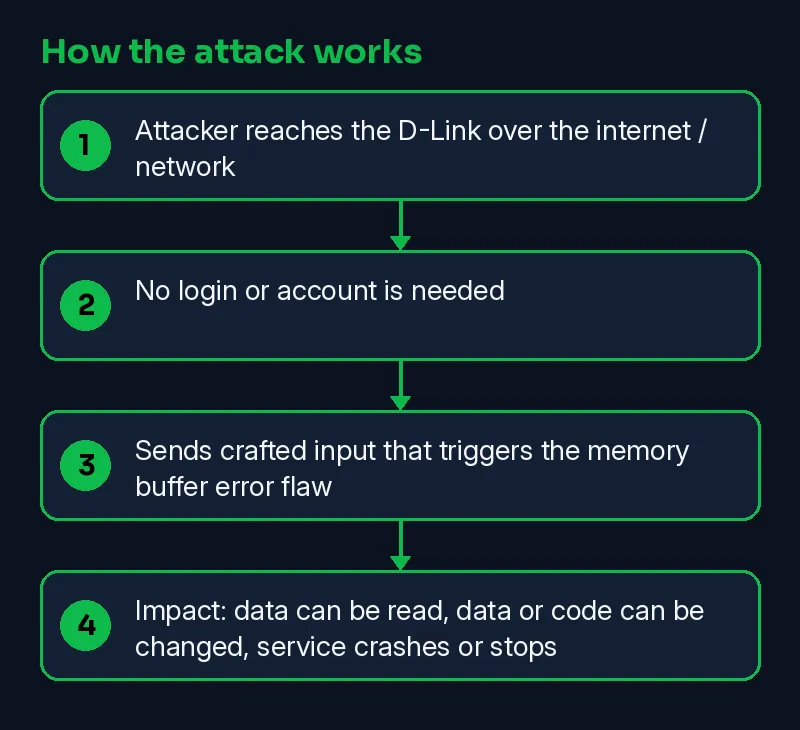
Attackers may exploit DDP vulnerabilities to gain unauthorized access, modify configurations, or disrupt services. Stack-based buffer overflow in udhcpcd may allow remote execution of code.
- Attacker reaches the D-Link over the internet / network
- No login or account is needed
- Sends crafted input that triggers the memory buffer error flaw
- Impact: data can be read, data or code can be changed, service crashes or stops
Skillmate analyst mapping (our judgement, not from the vendor):
- T1566 Phishing
Timeline
| Date | Event | Source |
|---|---|---|
| 2026-09-07 | CVE-2026-86296 published in NVD | NVD |
| 2026-11-06 | Reported by BleepingComputer | BleepingComputer |
| 2026-11-25 | This Skillmate explainer published | Skillmate |
How to fix it
- Update D-Link to the fixed release named in the vendor advisory.
- If you cannot patch today, limit who can reach the affected service and watch its logs.
How to detect it
Look for unauthorized changes to switch configurations, unexpected reboots, or resets.
What is confirmed and what is not
| Confirmed | Not confirmed yet |
|---|---|
| CVE-2026-86296 is a real NVD record scored 9.3 CRITICAL | CISA KEV does not list CVE-2026-86296 as exploited in the wild |
| Reported by BleepingComputer | NVD links no vendor advisory for CVE-2026-86296 yet |
Why it matters
These vulnerabilities threaten network security and could lead to data breaches, unauthorized access, and service disruptions, impacting businesses and users globally.
Learn the skills behind this story
Want to understand attacks like this and defend against them? Join Skillmate cybersecurity training or practise hands-on in Skillmate Labs.
FAQ
What are the DGS-3130 Series switches used for?
These switches are for small-to-medium businesses and metro Ethernet deployments, providing multi-gigabit uplinks.
What should I do to protect my DGS-3130 Series switches?
Disable DDP, remove default SNMP strings, restrict SSH, web UI, and SNMP access, and monitor logs for changes.
Are there any known vulnerabilities in D-Link DIR-822A routers?
Yes, there is a known stack-based buffer overflow vulnerability (CVE-2026-86296) affecting legacy DIR-822A routers.
Sources
- D-Link warns of multiple zero-days in DGS-3130 Series switches (BleepingComputer)
- NVD CVE record (NVD)
How we wrote this: facts come from the sources above, NVD and CISA KEV. An on-prem AI model drafted the plain-English parts and every sentence was checked against the sources; unsupported sentences were removed. MITRE mapping is our own judgement.
Watch today's video brief: https://youtu.be/kRYzVvFUDME