
Short answer: Hackers used refrigeration controllers to send spam and route proxy traffic. Anyone with internet-connected refrigeration systems may be affected.
TL;DR
- Hackers abused refrigeration controllers for spam and proxy
- Reportedly, systems in supermarkets, cold storage hit
- SecurityScorecard found weak signs of shared C2 infrastructure
- CVE-2026-25085 allowed unauth. access; update systems
What is CVE-2026-25085?
Hackers exploited vulnerabilities in internet-connected refrigeration controllers to send spam and route traffic. These controllers, used in supermarkets and cold storage, were found to be unpatched and insecure, allowing attackers to hijack them for malicious purposes.
- Vulnerability
- A mistake or weakness in software that an attacker can misuse.
- Exploit
- Code or steps that take advantage of a weakness.
- Unpatched
- No fix is available yet, or the fix has not been installed.
Key facts
| Reported by | Help Net Security |
|---|---|
| Date reported | 09 Nov 2026 |
| CVE | CVE-2026-25085 |
| CVSS | 9.8 CRITICAL CVSS:3.1/AV:N/AC:L/PR:N/UI:N/S:U/C:H/I:H/A:H |
| Weakness | CWE-394 (see NVD) |
| CISA KEV | Not listed (no confirmed exploitation in KEV) |
| Published in NVD | 2026-02-27 (CVE-2026-25085) |
How it works
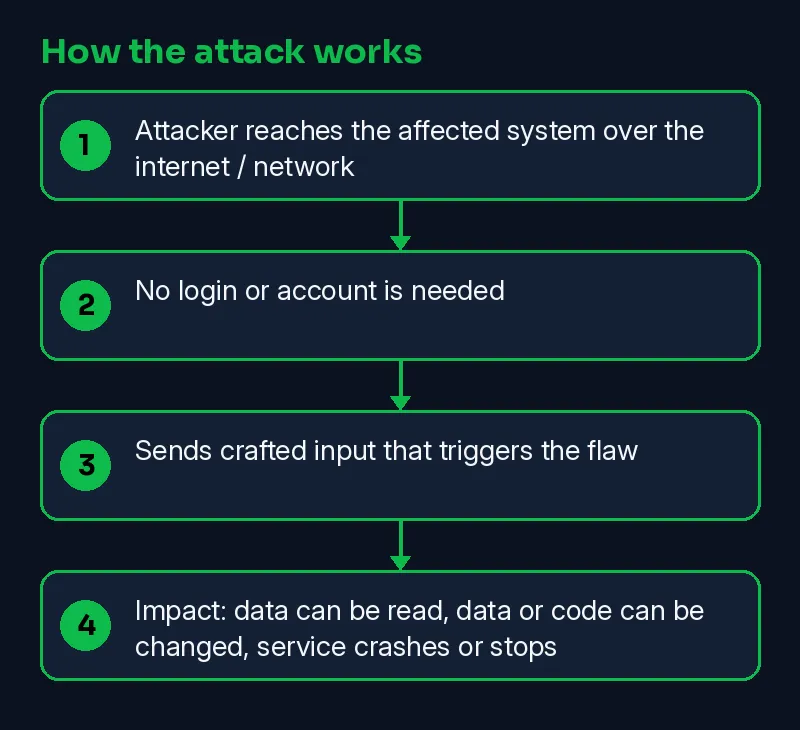
Hackers exploit a flaw in refrigeration controllers, which are internet-connected devices used in supermarkets. The flaw allows unauthorized access, enabling attackers to send spam and route proxy traffic.
- Attacker reaches the affected system over the internet / network
- No login or account is needed
- Sends crafted input that triggers the flaw
- Impact: data can be read, data or code can be changed, service crashes or stops
Timeline
| Date | Event | Source |
|---|---|---|
| 2026-02-27 | CVE-2026-25085 published in NVD | NVD |
| 2026-11-09 | Reported by Help Net Security | Help Net Security |
| 2026-11-27 | This Skillmate explainer published | Skillmate |
How to fix it
- If you cannot patch today, limit who can reach the affected service and watch its logs.
How to detect it
Look for unusual network traffic or emails sent from refrigeration controllers.
What is confirmed and what is not
| Confirmed | Not confirmed yet |
|---|---|
| CVE-2026-25085 is a real NVD record scored 9.8 CRITICAL | CISA KEV does not list CVE-2026-25085 as exploited in the wild |
| Reported by Help Net Security | NVD links no vendor advisory for CVE-2026-25085 yet |
Why it matters
Internet-connected devices in critical infrastructure can be exploited, affecting business operations and user data.
Learn the skills behind this story
Want to understand attacks like this and defend against them? Join Skillmate cybersecurity training or practise hands-on in Skillmate Labs.
FAQ
What are the signs of a compromised refrigeration controller?
Unusual network activity, unexpected emails, or temperature settings changes may indicate a compromised controller.
How can hackers use refrigeration controllers?
Hackers can use these controllers to send spam emails or route proxy traffic, turning them into part of a botnet.
What is the main vulnerability mentioned?
CVE-2026-25085 allows unauthorized access to refrigeration controllers by bypassing authentication.
Sources
- Hackers abuse refrigeration controllers to send spam and route proxy traffic (Help Net Security)
- NVD CVE record (NVD)
How we wrote this: facts come from the sources above, NVD and CISA KEV. An on-prem AI model drafted the plain-English parts and every sentence was checked against the sources; unsupported sentences were removed. MITRE mapping is our own judgement.
Watch today's video brief: https://youtu.be/fzBFP4ffN68