
Short answer: Crédit Mutuel Arkéa, a French bank, was targeted by hackers who stole funds via a service provider. Customers should be cautious of phishing attempts.
TL;DR
- French bank Crédit Mutuel Arkéa reports $133m heist.
- Attackers used service provider access.
- Funds were transferred to cryptocurrency exchanges.
- Bank reassures customers no financial impact.
What happened?
The stolen money was converted into cryptocurrencies, making recovery difficult. The bank is taking steps to secure customers' funds and warn against potential phishing attempts.
- Phishing
- Fake messages or websites that trick people into giving passwords or money.
Key facts
| Reported by | Infosecurity Magazine |
|---|---|
| Date reported | 09 Nov 2026 |
How it works
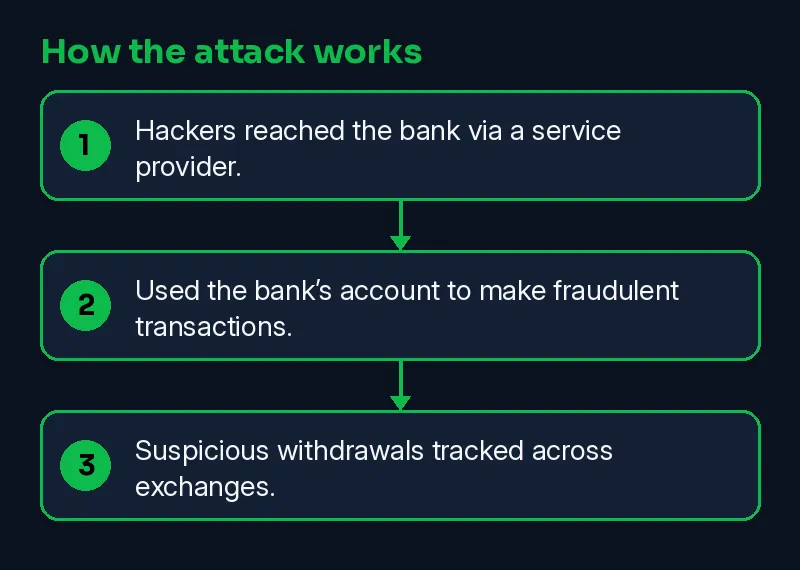
Hackers exploited a service provider to reach Crédit Mutuel Arkéa's network. They used the bank’s own account to make fraudulent transactions, converting the money into cryptocurrency.
- Hackers reached the bank via a service provider.
- Used the bank’s account to make fraudulent transactions.
- Suspicious withdrawals tracked across exchanges.
Skillmate analyst mapping (our judgement, not from the vendor):
- T1566 Phishing
Timeline
| Date | Event | Source |
|---|---|---|
| 2026-11-09 | Reported by Infosecurity Magazine | Infosecurity Magazine |
| 2026-11-26 | This Skillmate explainer published | Skillmate |
How to fix it
- If you keep crypto on an exchange, move long-term holdings to a wallet you control and turn on withdrawal address allow-lists.
- Use app-based or hardware-key two-factor authentication on exchange and wallet accounts, not SMS codes.
- Treat unexpected job offers, coding tests or trading apps sent over chat as suspicious; they are a common lure in crypto theft.
- Companies holding crypto: require more than one approver for large transfers and keep signing keys on separate, locked-down devices.
How to detect it
Signs to watch for:
- Withdrawals to new addresses, or at unusual sizes or times.
- New devices, API keys or withdrawal addresses added to exchange or wallet accounts.
- Developer tools, packages or 'trading' apps installed right after a recruiter or job chat.
What is confirmed
- Reported by Infosecurity Magazine
Why it matters
This incident highlights the need for robust security measures and careful management of third-party service providers.
Learn the skills behind this story
Want to understand attacks like this and defend against them? Join Skillmate cybersecurity training or practise hands-on in Skillmate Labs.
FAQ
What happened to Crédit Mutuel Arkéa?
A $133m heist reportedly targeted the bank. Hackers used the bank’s platform to make fraudulent transactions.
How did the hackers get in?
They reached the bank’s network through a service provider’s platform.
Are customers' funds safe?
The bank stated there are no financial consequences for customers.
What should customers look out for?
Be wary of phishing attempts in the wake of the incident.
Sources
- Crédit Mutuel Arkéa Targeted in Reported $133m Heist (Infosecurity Magazine)
How we wrote this: facts come from the sources above. An on-prem AI model drafted the plain-English parts and every sentence was checked against the sources; unsupported sentences were removed. MITRE mapping is our own judgement.
Watch today's video brief: https://youtu.be/fzBFP4ffN68