
Short answer: Cloud workloads saw a fourfold increase in high or critical vulnerabilities, affecting real-world applications. To mitigate, limit the blast radius of compromised applications and use short-lived credentials.
TL;DR
- Cloud workloads saw a fourfold increase in high or critical vulnerabilities.
- Long-lived credentials are a common cause of cloud breaches.
- 60% of organizations run versions of dependencies less than 24 hours old.
- Implement dependency cooldowns to lower risk of malicious dependencies.
What happened?
Cloud vulnerabilities surged, with applications and services in cloud environments facing more high or critical flaws. This is due to rapidly adopted, unvetted dependencies and long-lived credentials. To protect, organizations should limit the impact of compromised applications and use short-lived credentials for accessing cloud resources.
- Vulnerability
- A mistake or weakness in software that an attacker can misuse.
- Credentials / secrets
- Passwords, keys and tokens that prove who you are to a system.
Key facts
| Reported by | Infosecurity Magazine |
|---|---|
| Date reported | 10 Nov 2026 |
How it works
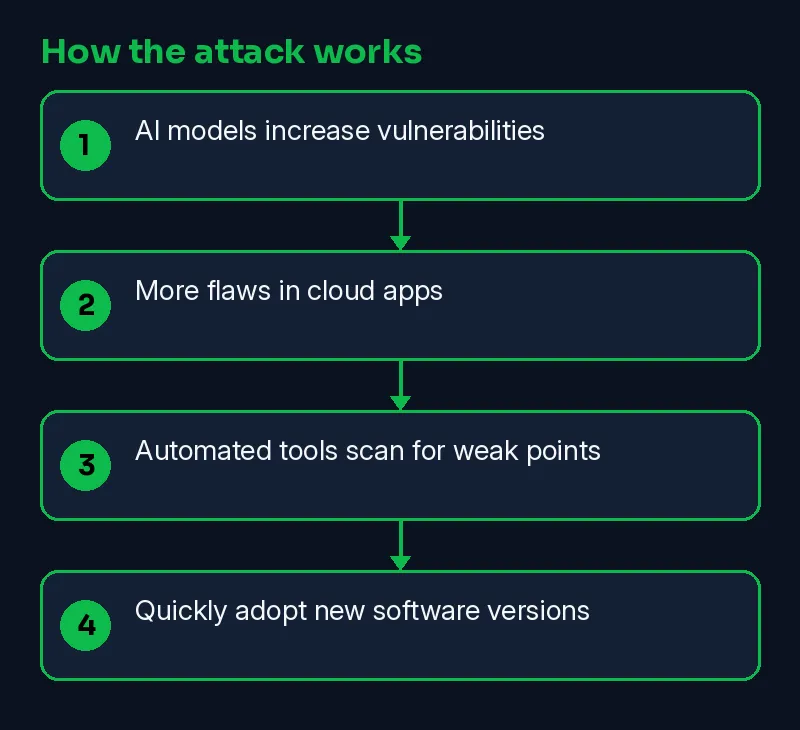
Cloud workloads have four times more high or critical vulnerabilities now, due to AI and third-party library issues. Attackers can find and use long-lived credentials easily. New versions of software dependencies can compromise cloud apps quickly.
- AI models increase vulnerabilities
- More flaws in cloud apps
- Automated tools scan for weak points
- Quickly adopt new software versions
Timeline
| Date | Event | Source |
|---|---|---|
| 2026-11-10 | Reported by Infosecurity Magazine | Infosecurity Magazine |
| 2026-11-28 | This Skillmate explainer published | Skillmate |
How to fix it
- If you have an account with the affected company, change that password and any reused copies of it.
- Turn on two-factor authentication (a second login step) wherever the service offers it.
- Expect phishing emails or calls that use the exposed details; verify requests through official channels.
How to detect it
Signs to watch for:
- Login alerts from new devices or locations on the affected account.
- Password-reset emails you did not ask for.
- Phishing messages that quote your real account details.
What is confirmed
- Reported by Infosecurity Magazine
Why it matters
Cloud security is crucial. More vulnerabilities mean higher risk of breaches. Long-lived keys and unvetted dependencies can lead to unauthorized access.
Learn the skills behind this story
Want to understand attacks like this and defend against them? Join Skillmate cybersecurity training or practise hands-on in Skillmate Labs.
FAQ
What are the main threats to cloud security?
Supply-chain attacks through hijacked dependencies and long-lived credentials are major threats.
What are dependency cooldowns?
Dependency cooldowns delay the automatic adoption of new software versions to reduce the risk of malicious updates.
Sources
- Cloud Vulnerabilities Surge Fourfold in Less Than a Year (Infosecurity Magazine)
How we wrote this: facts come from the sources above. An on-prem AI model drafted the plain-English parts and every sentence was checked against the sources; unsupported sentences were removed. MITRE mapping is our own judgement.
Watch today's video brief: https://youtu.be/e-8gKIJlbPQ