
Short answer: CISA flagged a critical Cisco RCE flaw as actively exploited. Federal agencies must secure systems.
TL;DR
- CISA flagged a critical Cisco RCE flaw.
- Cisco Expressway devices are affected.
- Attackers are exploiting this flaw in the wild.
- Federal agencies must secure their systems.
What is CVE-2026-20320?
CISA flagged a critical Cisco RCE flaw that allows unauthenticated attackers to execute commands as root on Cisco Expressway devices. This vulnerability stems from hard-coded credentials and insufficient client certificate validation. Attackers have exploited this flaw in the wild, especially targeting federal agencies. Federal defenders must prioritize patching to mitigate risks.
- RCE (remote code execution)
- An attacker can run their own commands on someone else's computer or server over the internet.
- Vulnerability
- A mistake or weakness in software that an attacker can misuse.
- Patch
- A software update from the maker that fixes a security weakness.
- Exploit
- Code or steps that take advantage of a weakness.
- Credentials / secrets
- Passwords, keys and tokens that prove who you are to a system.
Key facts
| Reported by | BleepingComputer |
|---|---|
| Date reported | 23 Nov 2026 |
| CVE | CVE-2026-20320 |
| CVSS | 7.5 HIGH CVSS:3.1/AV:N/AC:L/PR:N/UI:N/S:U/C:H/I:N/A:N |
| Weakness | CWE-611 (XML external entity) |
| CISA KEV | Yes, added 2026-11-10; federal due date 2026-11-24 |
| Ransomware use | Unknown (CISA KEV) |
| Vendor advisory | sec.cloudapps.cisco.com |
| CVE | CVE-2026-7646 |
| CVSS | 6.5 MEDIUM CVSS:3.1/AV:N/AC:L/PR:L/UI:N/S:U/C:H/I:N/A:N |
| Weakness | CWE-22 (path traversal) |
| CISA KEV | Not listed (no confirmed exploitation in KEV) |
| Vendor advisory | www.ibm.com |
| CVE | CVE-2026-76466 |
| CVSS | 9.8 CRITICAL CVSS:3.1/AV:N/AC:L/PR:N/UI:N/S:U/C:H/I:H/A:H |
| Weakness | CWE-798 (hard-coded credentials) |
| CISA KEV | Yes, added 2026-11-20; federal due date 2026-11-23 |
| Ransomware use | Unknown (CISA KEV) |
| Vendor advisory | sec.cloudapps.cisco.com |
| Affected product | Cisco BroadWorks |
| Published in NVD | 2026-08-19 (CVE-2026-20320) |
| Published in NVD | 2026-08-05 (CVE-2026-7646) |
| Published in NVD | 2026-10-21 (CVE-2026-76466) |
How it works
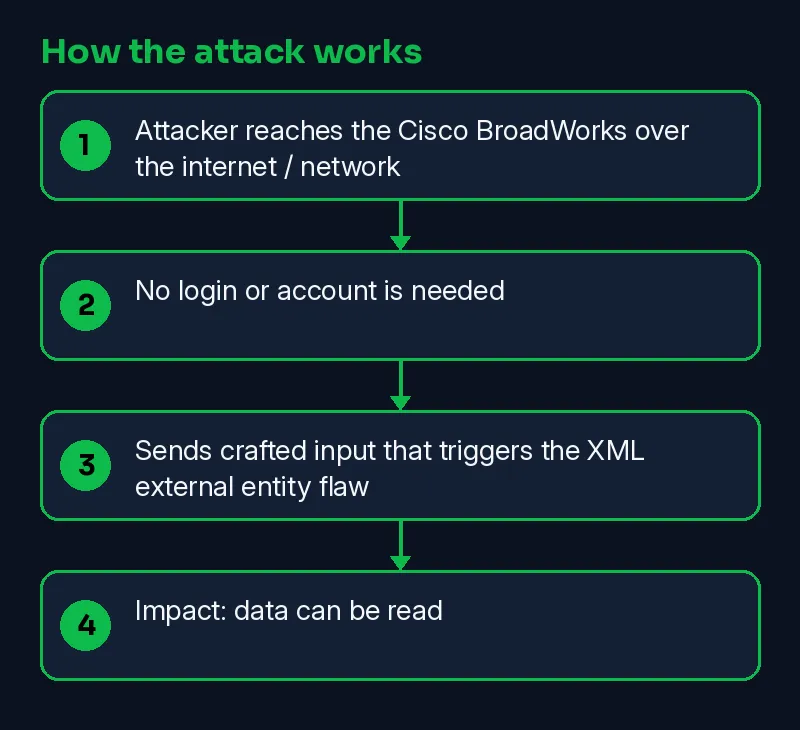
Another bug in Cisco BroadWorks lets attackers read sensitive files with user privileges.
- Attacker reaches the Cisco BroadWorks over the internet / network
- No login or account is needed
- Sends crafted input that triggers the XML external entity flaw
- Impact: data can be read
Skillmate analyst mapping (our judgement, not from the vendor):
- T1190 Exploit Public-Facing Application
Timeline
| Date | Event | Source |
|---|---|---|
| 2026-08-05 | CVE-2026-7646 published in NVD | NVD |
| 2026-08-19 | CVE-2026-20320 published in NVD | NVD |
| 2026-10-21 | CVE-2026-76466 published in NVD | NVD |
| 2026-11-10 | CVE-2026-20320 added to CISA KEV (actively exploited) | CISA KEV |
| 2026-11-20 | CVE-2026-76466 added to CISA KEV (actively exploited) | CISA KEV |
| 2026-11-23 | Reported by BleepingComputer | BleepingComputer |
| 2026-11-23 | US federal agencies must patch by this date | CISA KEV |
| 2026-11-24 | This Skillmate explainer published | Skillmate |
| 2026-11-24 | US federal agencies must patch by this date | CISA KEV |
How to fix it
- Update Cisco BroadWorks to the fixed release named in the vendor advisory.
- Read the vendor advisory for CVE-2026-20320 and upgrade to the fixed release it lists.
- CVE-2026-20320 is in CISA KEV: treat it as actively exploited and patch first.
- Read the vendor advisory for CVE-2026-7646 and upgrade to the fixed release it lists.
- Read the vendor advisory for CVE-2026-76466 and upgrade to the fixed release it lists.
- CVE-2026-76466 is in CISA KEV: treat it as actively exploited and patch first.
- If you cannot patch today, limit who can reach the affected service and watch its logs.
How to detect it
Defenders can look for unauthorized command execution logs, root-level access attempts, and database service invocations.
What is confirmed and what is not
| Confirmed | Not confirmed yet |
|---|---|
| CVE-2026-20320 is a real NVD record scored 7.5 HIGH | CISA KEV does not list CVE-2026-7646 as exploited in the wild |
| CISA lists CVE-2026-20320 as exploited in the wild | |
| CVE-2026-7646 is a real NVD record scored 6.5 MEDIUM | |
| CVE-2026-76466 is a real NVD record scored 9.8 CRITICAL | |
| CISA lists CVE-2026-76466 as exploited in the wild | |
| Reported by BleepingComputer | |
| Reported by sec.cloudapps.cisco.com | |
| Reported by www.ibm.com |
Why it matters
Companies and users must patch to avoid risks.
Learn the skills behind this story
Want to understand attacks like this and defend against them? Join Skillmate cybersecurity training or practise hands-on in Skillmate Labs.
FAQ
What is CVE-2026-76466?
CVE-2026-76466 is a critical Cisco Expressway Series flaw that allows unauthenticated attackers to execute commands as root. It is actively exploited.
How does CVE-2026-76466 work?
Attackers use persistent cookies to connect to the database service and run RPC commands, gaining root access.
Is CVE-2026-76466 in CISA's KEV?
Yes, CISA has listed CVE-2026-76466 in its Known Exploited Vulnerabilities (KEV) Catalog, marking it as actively exploited.
What is CISA's advice for CVE-2026-76466?
CISA urges all network defenders to patch the vulnerability to block ongoing attacks targeting their networks.
Related Skillmate posts
Sources
- CISA flags critical Cisco RCE flaw as actively exploited in attacks (BleepingComputer)
- Vendor advisory CVE-2026-20320 (sec.cloudapps.cisco.com)
- Vendor advisory CVE-2026-7646 (www.ibm.com)
- Vendor advisory CVE-2026-76466 (sec.cloudapps.cisco.com)
- NVD CVE record (NVD)
How we wrote this: facts come from the sources above, NVD and CISA KEV. An on-prem AI model drafted the plain-English parts and every sentence was checked against the sources; unsupported sentences were removed. MITRE mapping is our own judgement.