
Short answer: CEO-spoofing scammers used AI to trick employees into sending money. Companies were defrauded of over $100 million. Be wary of unexpected calls and emails, especially from higher-ups.
TL;DR
- Scammers used AI to impersonate CEOs.
- Companies lost over $100 million.
- Fraudsters are facing charges in multiple countries.
- Examine requests for money closely.
What happened?
CEO-spoofing is a scam where scammers pretend to be a company's CEO. They use AI to make their voice sound like the CEO's. They trick employees into sending money to accounts controlled by the scammers. This incident highlights the importance of verifying requests before sending money.
Key facts
| Reported by | The Record |
|---|---|
| Date reported | 06 Nov 2026 |
| Amount reported | $100 million (as reported by The Record) |
How it works
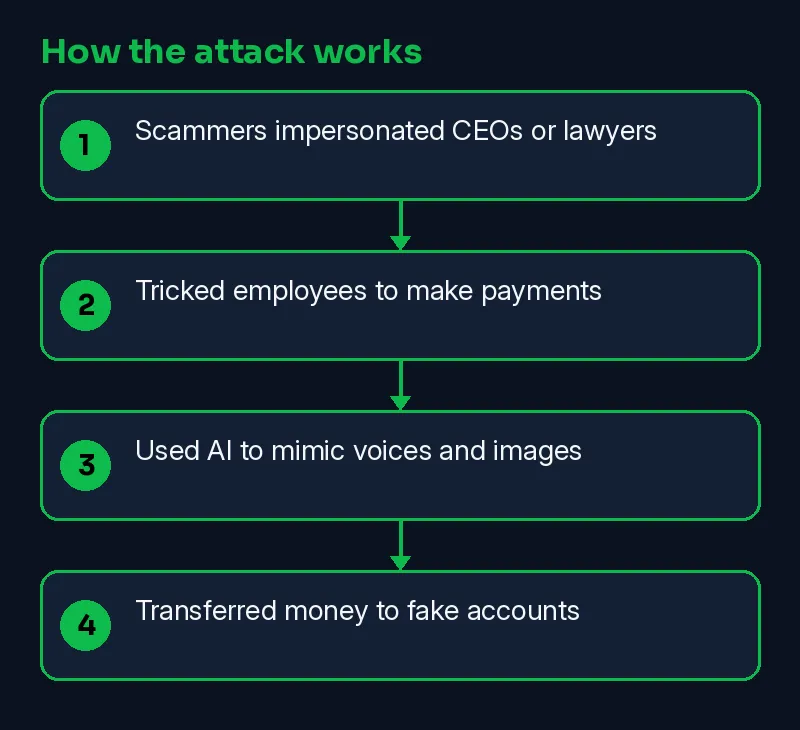
Scammers used AI to impersonate CEOs or lawyers, tricking employees into sending money to fake accounts. They mimicked voices and images, often using AI to make calls sound like legal advice.
- Scammers impersonated CEOs or lawyers
- Tricked employees to make payments
- Used AI to mimic voices and images
- Transferred money to fake accounts
Skillmate analyst mapping (our judgement, not from the vendor):
- T1566 Phishing
Timeline
| Date | Event | Source |
|---|---|---|
| 2026-11-06 | Reported by The Record | The Record |
| 2026-11-25 | This Skillmate explainer published | Skillmate |
How to fix it
- Check the sender address and the real link destination before clicking.
- Never share one-time passwords or login codes with anyone.
- Report the message to your IT team or the service's official abuse address.
How to detect it
Defenders should look for unusual bank transfers, unexpected calls from CEOs, and spoofed emails.
Signs to watch for:
- Messages that push urgency, payment changes or login links.
- Sender domains that look like, but are not, the real company.
- Logins to your accounts right after someone clicked a link.
What is confirmed
- The Record reports the amount as $100 million
- Reported by The Record
Why it matters
This matters because such attacks can lead to significant financial loss. Companies and users must be vigilant and verify requests before making large payments.
Learn the skills behind this story
Want to understand attacks like this and defend against them? Join Skillmate cybersecurity training or practise hands-on in Skillmate Labs.
FAQ
What is CEO-spoofing?
CEO-spoofing is a scam where scammers pretend to be a company's CEO to trick employees into making unauthorized payments.
How can I avoid CEO-spoofing scams?
Verify the identity of the CEO by calling them directly on a known number and confirm any unusual requests.
What technology do scammers use?
Scammers reportedly used AI to impersonate CEOs and lawyers, making the scam more convincing.
What can companies do to protect against these scams?
Companies should implement strict verification procedures for financial transactions and train employees on recognizing phishing attempts.
Sources
How we wrote this: facts come from the sources above. An on-prem AI model drafted the plain-English parts and every sentence was checked against the sources; unsupported sentences were removed. MITRE mapping is our own judgement.
Watch today's video brief: https://youtu.be/kRYzVvFUDME