
Short answer: VMware vCenter flaws allow attackers to gain unauthorized access, and Red Hat Linux kernel flaw can cause system crashes. Secure your systems, apply patches, and limit access.
TL;DR
- VMware vCenter exploited by attackers.
- Red Hat Linux kernel flaw can cause crashes.
- New AI threats use phishing with AI.
- Cloud breaches used to target wider networks.
What is CVE-2026-123890?
This issue involves vulnerabilities in VMware vCenter and the Red Hat Linux kernel. VMware vCenter has an authentication-bypass flaw allowing unauthorized access, while the Linux kernel has an out-of-bounds memory write vulnerability. Red Hat advises patching and limiting access. New attacks use AI for phishing, and attackers exploit cloud breaches to target other networks.
- Vulnerability
- A mistake or weakness in software that an attacker can misuse.
- Patch
- A software update from the maker that fixes a security weakness.
- Zero-day
- A weakness attackers use before the maker has released a fix.
- Data breach
- When private information is stolen or exposed to people who should not see it.
- Phishing
- Fake messages or websites that trick people into giving passwords or money.
- Exploit
- Code or steps that take advantage of a weakness.
Key facts
| Reported by | The Hacker News |
|---|---|
| Date reported | 23 Nov 2026 |
| CVE | CVE-2026-123890 |
| CVSS | 9.8 CRITICAL CVSS:3.1/AV:N/AC:L/PR:N/UI:N/S:U/C:H/I:H/A:H |
| Weakness | CWE-288 (authentication bypass) |
| CISA KEV | Yes, added 2026-11-20; federal due date 2026-11-23 |
| Ransomware use | Unknown (CISA KEV) |
| Vendor advisory | support.broadcom.com |
| CVE | CVE-2026-99362 |
| CVSS | 9.8 CRITICAL CVSS:3.1/AV:N/AC:L/PR:N/UI:N/S:U/C:H/I:H/A:H |
| CISA KEV | Not listed (no confirmed exploitation in KEV) |
| Affected product | Broadcom VMware vCenter |
| Published in NVD | 2026-11-19 (CVE-2026-123890) |
| Published in NVD | 2026-11-19 (CVE-2026-99362) |
How it works
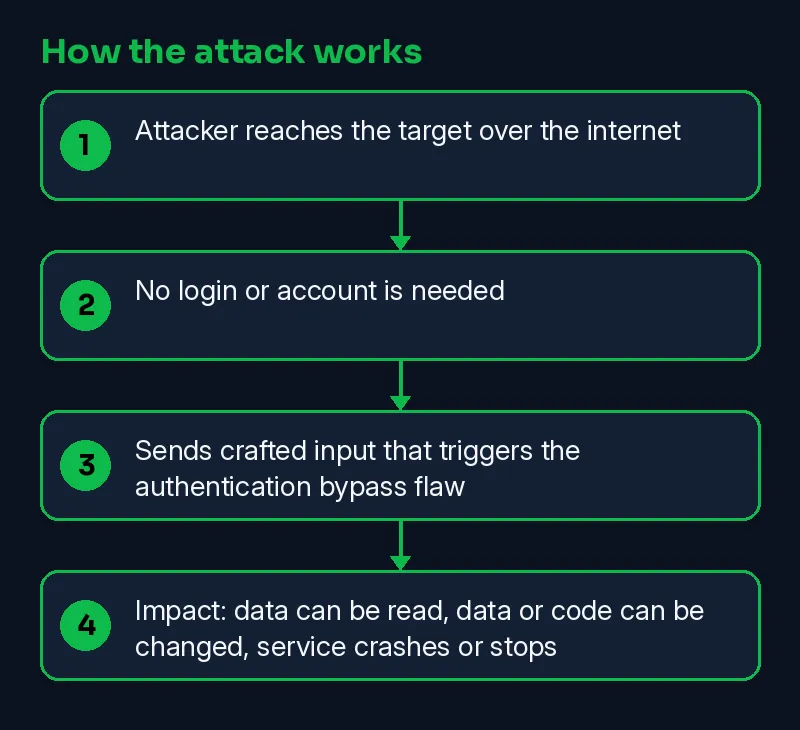
A flaw in VMware vCenter allows attackers to bypass authentication, gaining unauthorized access. An attacker controls a cloud account, steals a key, and uses it to copy data, then exploits a vulnerability to execute code.
- Attacker reaches the target over the internet
- No login or account is needed
- Sends crafted input that triggers the authentication bypass flaw
- Impact: data can be read, data or code can be changed, service crashes or stops
Skillmate analyst mapping (our judgement, not from the vendor):
Timeline
| Date | Event | Source |
|---|---|---|
| 2026-11-19 | CVE-2026-123890 published in NVD | NVD |
| 2026-11-19 | CVE-2026-99362 published in NVD | NVD |
| 2026-11-20 | CVE-2026-123890 added to CISA KEV (actively exploited) | CISA KEV |
| 2026-11-23 | Reported by The Hacker News | The Hacker News |
| 2026-11-23 | US federal agencies must patch by this date | CISA KEV |
| 2026-11-24 | This Skillmate explainer published | Skillmate |
Am I affected?
These commands only read the version or settings. Compare the output with the vendor advisory linked in the facts table.
Linux kernel
shows the running kernel version:
uname -rHow to fix it
- Update Broadcom VMware vCenter to the fixed release named in the vendor advisory.
- Read the vendor advisory for CVE-2026-123890 and upgrade to the fixed release it lists.
- CVE-2026-123890 is in CISA KEV: treat it as actively exploited and patch first.
- If you cannot patch today, limit who can reach the affected service and watch its logs.
How to detect it
Look for unauthorized access attempts, crashes, and unexpected logins.
What is confirmed and what is not
| Confirmed | Not confirmed yet |
|---|---|
| CVE-2026-123890 is a real NVD record scored 9.8 CRITICAL | CISA KEV does not list CVE-2026-99362 as exploited in the wild |
| CISA lists CVE-2026-123890 as exploited in the wild | NVD links no vendor advisory for CVE-2026-99362 yet |
| CVE-2026-99362 is a real NVD record scored 9.8 CRITICAL | |
| Reported by The Hacker News | |
| Reported by access.redhat.com | |
| Reported by github.com | |
| Reported by support.broadcom.com |
Why it matters
Vulnerabilities like these can lead to data breaches and unauthorized access, impacting businesses and users globally. Companies must stay vigilant and regularly update their systems.
Learn the skills behind this story
Want to understand attacks like this and defend against them? Join Skillmate cybersecurity training or practise hands-on in Skillmate Labs.
FAQ
What is a 0-Day vulnerability?
A 0-Day vulnerability is a security flaw that attackers exploit before a patch is available. VMware vCenter Server had one in September 2026, allowing unauthorized access.
What is path traversal in the context of data uploads?
Path traversal allows attackers to write files to unintended locations. MONAI Label's datastore upload had such a flaw, letting users write files anywhere.
What is a critical vulnerability?
A critical vulnerability is one that could allow remote code execution or a complete system crash. VMware's vCenter Directory Service flaw was critical.
Related Skillmate posts
Sources
- Weekly Recap: VMware 0-Day, Java4Shell, NGINX2Root, Ruby2Shell, and a Whole Lot of Shell Trouble (The Hacker News)
- Primary source / advisory (access.redhat.com)
- Primary source / advisory (github.com)
- Vendor advisory CVE-2026-123890 (support.broadcom.com)
- NVD CVE record (NVD)
How we wrote this: facts come from the sources above, NVD and CISA KEV. An on-prem AI model drafted the plain-English parts and every sentence was checked against the sources; unsupported sentences were removed. MITRE mapping is our own judgement.