
Short answer: Blind Eagle targeted Latin American organizations with fake court notices. Be cautious of suspicious emails and attachments.
TL;DR
- Blind Eagle used fake court notices to distribute malware.
- The attacks targeted judicial, fiscal, administrative, and educational organizations.
- Organizations should be wary of suspicious emails, especially those with attachments.
What happened?
Blind Eagle is a cyber threat actor that uses fake court notices to distribute a Remote Access Trojan (RAT) in Latin America. The RAT allows attackers to control infected systems. This campaign may compromise sensitive information and critical infrastructure. Stay alert and keep your systems updated.
Key facts
| Reported by | The Hacker News |
|---|---|
| Date reported | 10 Nov 2026 |
How it works
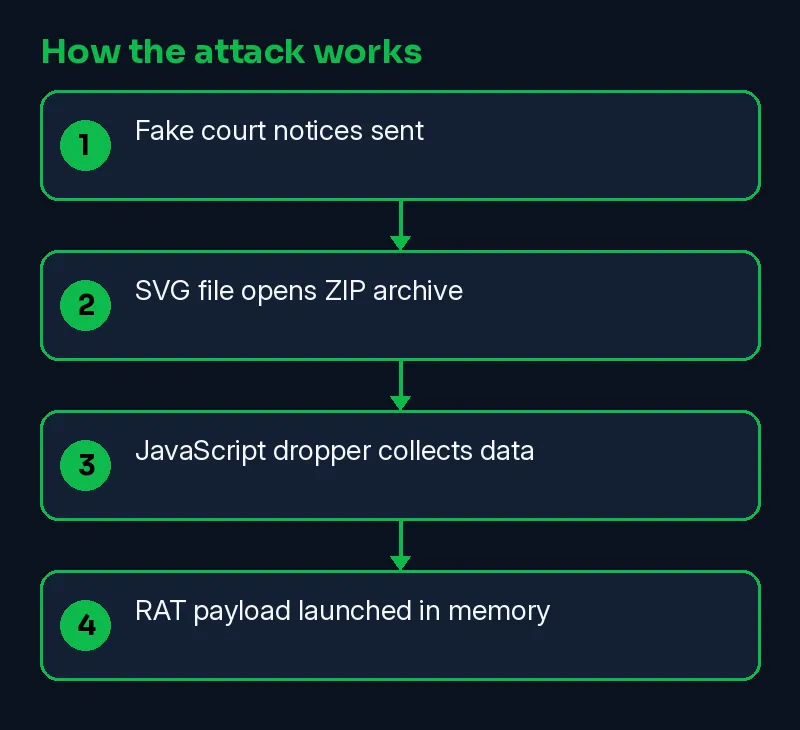
Blind Eagle sends fake court notices, tricking users into opening malicious attachments. The attachments are SVG files that hide a ZIP archive with a JavaScript dropper. The dropper collects system info and launches the RAT payload.
- Fake court notices sent
- SVG file opens ZIP archive
- JavaScript dropper collects data
- RAT payload launched in memory
Skillmate analyst mapping (our judgement, not from the vendor):
- T1566 Phishing
Timeline
| Date | Event | Source |
|---|---|---|
| 2026-11-10 | Reported by The Hacker News | The Hacker News |
| 2026-11-28 | This Skillmate explainer published | Skillmate |
How to fix it
- Keep the operating system, browser and security software updated.
- Do not open unexpected attachments or install software from unofficial sources.
- Report suspicious files or pop-ups to your IT or security team.
How to detect it
Defenders should look for suspicious emails with court notices, fiscalía notices, and administrative documents. Watch for fake web pages that look like legal institutions.
Signs to watch for:
- Unknown programs starting at boot, or new scheduled tasks.
- Security software that was turned off without a reason.
- Unusual outbound connections from a workstation.
What is confirmed
- Reported by The Hacker News
Why it matters
This attack targets sensitive data in Latin America, including judicial and financial information. It shows the risks of opening suspicious emails and highlights the need for better security practices globally.
Learn the skills behind this story
Want to understand attacks like this and defend against them? Join Skillmate cybersecurity training or practise hands-on in Skillmate Labs.
Related Skillmate posts
Sources
- Blind Eagle Uses Fake Court Notices to Deliver Remote Access Trojan Across Latin America (The Hacker News)
How we wrote this: facts come from the sources above. An on-prem AI model drafted the plain-English parts and every sentence was checked against the sources; unsupported sentences were removed. MITRE mapping is our own judgement.
Watch today's video brief: https://youtu.be/e-8gKIJlbPQ