
Short answer: Companies should improve cybersecurity and verify identities.
TL;DR
- AI used to make fake voices and images.
- Companies lost $129M in fraud.
- Trio targeted accounting staff and executives.
- Funds converted to cryptocurrency and laundered.
What happened?
This incident involves criminals using artificial intelligence (AI) to create fake voices and images of CEOs and lawyers. The fraudsters began by targeting accounting staff and used emails and fake calls to trick employees. They then impersonated real lawyers to make the transactions seem legitimate.
Key facts
| Reported by | CyberScoop |
|---|---|
| Date reported | 06 Nov 2026 |
How it works
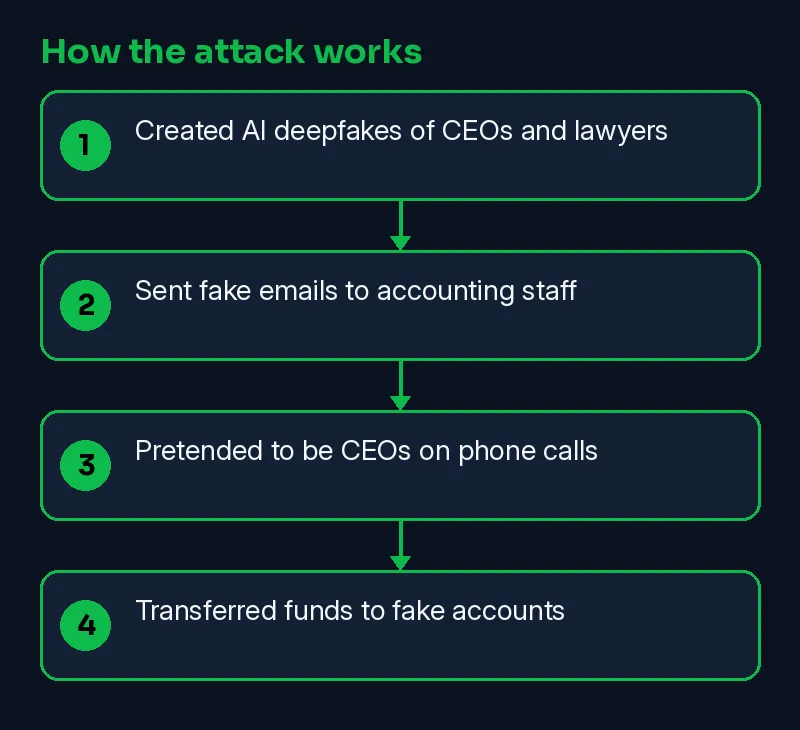
The attackers used AI to create fake voices and images of CEOs and lawyers. They tricked employees by sending emails and making phone calls, pretending to be CEOs. Employees were then directed to transfer money to fake accounts.
- Created AI deepfakes of CEOs and lawyers
- Sent fake emails to accounting staff
- Pretended to be CEOs on phone calls
- Transferred funds to fake accounts
Timeline
| Date | Event | Source |
|---|---|---|
| 2026-11-06 | Reported by CyberScoop | CyberScoop |
| 2026-11-25 | This Skillmate explainer published | Skillmate |
How to fix it
- Keep systems and network devices updated and follow vendor security notices.
- Make sure an incident response contact and plan exist before an attack happens.
- Ask your service providers which protections they offer, and test them.
How to detect it
Look for unusual emails or calls, especially those asking for money transfers.
What is confirmed
- Reported by CyberScoop
Why it matters
This matters because it highlights the growing threat of AI in fraud. Companies need to be vigilant and train employees to recognize such attacks.
Learn the skills behind this story
Want to understand attacks like this and defend against them? Join Skillmate cybersecurity training or practise hands-on in Skillmate Labs.
FAQ
What are the consequences of such a fraud?
The fraudsters could face up to 104 years in prison, depending on the charges.
How did the fraudsters carry out the scam?
They impersonated CEOs and lawyers, tricked employees into transferring money, and used AI to create convincing voice and video messages.
Sources
How we wrote this: facts come from the sources above. An on-prem AI model drafted the plain-English parts and every sentence was checked against the sources; unsupported sentences were removed. MITRE mapping is our own judgement.
Watch today's video brief: https://youtu.be/kRYzVvFUDME