
Short answer: Hackers can use stolen credentials to log in in just 8 minutes.
TL;DR
- Stolen credentials can be used within 8 minutes.
- Phishing and trusted apps are common entry points.
- Remote monitoring tools can give attackers access.
What happened?
Hackers can use stolen credentials to quickly gain access to systems. This happens because users often reuse passwords and attackers can exploit trusted applications. Remote monitoring tools can also be misused to control devices.
- Phishing
- Fake messages or websites that trick people into giving passwords or money.
- Credentials / secrets
- Passwords, keys and tokens that prove who you are to a system.
Key facts
| Reported by | Help Net Security |
|---|---|
| Date reported | 09 Nov 2026 |
How it works
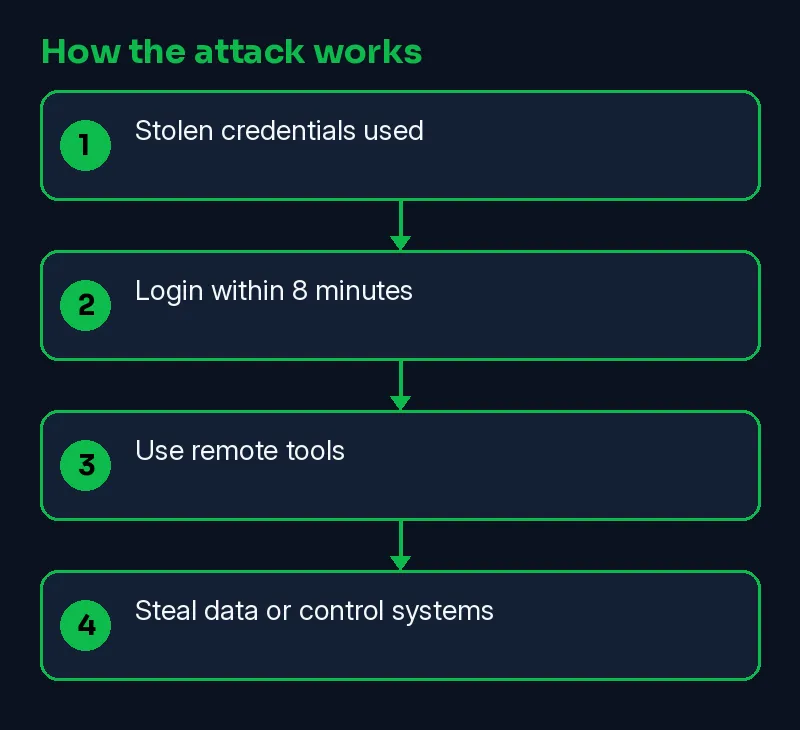
Hackers use stolen credentials to access accounts quickly. They may use phishing or other methods to get these.
- Stolen credentials used
- Login within 8 minutes
- Use remote tools
- Steal data or control systems
Timeline
| Date | Event | Source |
|---|---|---|
| 2026-11-09 | Reported by Help Net Security | Help Net Security |
| 2026-11-25 | This Skillmate explainer published | Skillmate |
How to fix it
- If you have an account with the affected company, change that password and any reused copies of it.
- Turn on two-factor authentication (a second login step) wherever the service offers it.
- Expect phishing emails or calls that use the exposed details; verify requests through official channels.
How to detect it
Look for unusual logins, especially those from unknown locations. A user logging in with stolen credentials may seem like normal activity, making it hard to spot. Check for signs of phishing attempts, like unfamiliar verification pages.
Signs to watch for:
- Login alerts from new devices or locations on the affected account.
- Password-reset emails you did not ask for.
- Phishing messages that quote your real account details.
What is confirmed
- Reported by Help Net Security
Why it matters
Quick access means severe risks. Companies must protect credentials and monitor systems. Users should be wary of phishing and keep passwords strong.
Learn the skills behind this story
Want to understand attacks like this and defend against them? Join Skillmate cybersecurity training or practise hands-on in Skillmate Labs.
FAQ
What is an infostealer?
An infostealer is a type of malware that collects and sends sensitive information, such as passwords and payment details, to attackers.
How can attackers use AI applications?
Attackers can use AI applications like Claude Code and ChatGPT to execute system commands and access sensitive information.
Sources
- An average of 8 minutes is all hackers need to log in with stolen credentials (Help Net Security)
How we wrote this: facts come from the sources above. An on-prem AI model drafted the plain-English parts and every sentence was checked against the sources; unsupported sentences were removed. MITRE mapping is our own judgement.
Watch today's video brief: https://youtu.be/fzBFP4ffN68